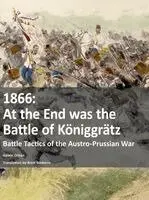
1866 - At the End was the Battle of Koeniggratz
- Vikt 1,05 kg
466 krhos Bokus · exkl. frakt
143 kr skillnad mellan billigaste och dyraste butik i lager
Dubbelkollade priser
Jämför 3 butiker
- Bokus, 466 kr, frakt enligt butiken. Till butik (öppnas i ny flik)
I lagerFrakt: se butikenDubbelkollad 11:51
466 kr
Lägst
- Akademibokhandeln, 609 kr, frakt enligt butiken. Till butik (öppnas i ny flik)
I lagerFrakt: se butikenDubbelkollad 11:53
609 kr
- Adlibris, 431 kr, frakt enligt butiken. Till butik (öppnas i ny flik)
Slut i lagerFrakt: se butikenDubbelkollad 27 okt. 09:10
431 kr


Priser från butikernas flöden kan ha ändrats: det är priset hos butiken som gäller, så kontrollera det innan du handlar.
Prishistorik
Köp nu eller vänta?
Just nu kostar produkten 466 kr — 41 kr över det lägsta vi sett på 1 månad.
Under den tiden har det oftast legat runt 430 kr.
Pris idag
466 kr
- Lägst
- 425 kr
- Snitt
- 436 kr
- Högst
- 466 kr
| 2026-09-15 | 425 kr · Lägst hos Adlibris |
|---|---|
| 2026-09-17 | 431 kr · Lägst hos Adlibris |
| 2026-10-06 | 456 kr · Lägst hos Bokus |
| 2026-10-08 | 431 kr · Lägst hos Adlibris |
| 2026-10-27 | 466 kr · Lägst hos Bokus |
Om produkten
1866 - At the End was the Battle of Koeniggratz
Läs merLäs mindre
The scholarly inquiry of the causes of Austrias defeat in 1866 is almost asold as the war against rising Prussia itself. Already in the immediateaftermath of the conflict, considerable energy was devoted to identifying thesources of failure. At the time, responsibility was attributed to themisjudgements of the high command, and above all to the commander-in-chief ofthe k.k. North Army, Feldzeugmeister Ludwig von Benedek. This one-sidedinterpretation, together with the broader debate surrounding the so-calledquestion of guilt (Schuldfrage), was later treated with increasing nuance.During the twentieth century, historians sought the origins of the defeat atboth political and military levels. From a military perspective, research hasprimarily examined developments in armaments technology, the (strategic-)operational miscalculations of the campaign, and the structural deficiencies ofthe k.k. Army, which stemmed in large part from severe budgetary restrictions.By contrast, comparatively little attention has been devoted to battle tactics.In 1866, Austria entered the war against Prussia with a tactical doctrinenearly sixty years old, based on an overestimation of the historical traditionof military values. This volume examines precisely this neglected aspect. Within the broadercontext of armed conflicts since the Revolutionary and Napoleonic Wars againstFrance, it introduces and systematically analyses Austrian military doctrine,with particular emphasis on tactics. The study critically examines the outdatedsystems of recruitment and training, while also considering the related fieldsof uniforms and equipment, soldiers daily life, and military communication. Theinvestigation, however, focuses primarily on two main themes: first, theAustrians disdain for the employment of firearms; and second, their unshakeablebelief in the invincibility of their own close-order battle formations. Thebayonet charge, in particular, was accorded a special and almost emblematicstatus. The volume further explores the interaction between the various arms inwartime and highlights the complex interrelationship between strategic andtactical concepts. It becomes clear that the k.k. Austrian Army was among thevery last of the truly Napoleonic forces; an army whose admirable courage couldno longer compensate for hopelessly outdated infantry tactics in the age ofindustrialised warfare.
Specifikationer
Fakta
- Vikt
- 1,05 kg
- GTIN
- 09783963600746
Uppgifter från tillverkare och butiker.