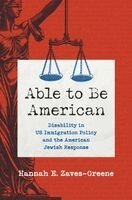
Able to Be American
368 krhos Bokus · exkl. frakt
111 kr skillnad mellan billigaste och dyraste butik i lager
Dubbelkollat idag
Jämför 2 butiker
- Bokus, 368 kr, frakt enligt butiken. Till butik (öppnas i ny flik)
I lagerFrakt: se butikenDubbelkollad 22:51
368 kr
Lägst
- Akademibokhandeln, 479 kr, frakt enligt butiken. Till butik (öppnas i ny flik)
I lagerFrakt: se butikenDubbelkollad 22:53
479 kr

Priser från butikernas flöden kan ha ändrats: det är priset hos butiken som gäller, så kontrollera det innan du handlar.
Prishistorik
Köp nu eller vänta?
Pris idag
368 kr
- Lägst
- 366 kr
- Snitt
- 389 kr
- Högst
- 479 kr
| 2026-10-12 | 479 kr · Lägst hos Akademibokhandeln |
|---|---|
| 2026-10-13 | 366 kr · Lägst hos Bokus |
| 2026-10-16 | 368 kr · Lägst hos Bokus |
Om produkten
Able to Be American
Läs merLäs mindre
Epilepsy. Heart disease. Varicose veins. "Feeble-mindedness." In 1891, Congress unambiguously codified the popular sentiment that "defects" like these should preclude admission to the United States. Expanding the eugenics-rooted restrictions of the 1882 Immigration Act, the new law conflated illness, poverty, and disability with criminality and "moral turpitude," starkly revealing Congress's vision of the "ideal" American. Simultaneously, American Jews sought security and acceptance in the United States. In confronting these fraught issues, they boldly asserted that they too had the right, knowledge, and ability to shape the meaning of American national belonging and, indeed, the fabric of the country itself. Able to be American explores this tension, revealing how eugenic theories about illness and disability fundamentally shaped American society, government, and everyday life. As Jewish communal leaders contested the thorny relationship between perceived able-bodiedness and the "ability" to become American, they strove to reform federal immigration law and its implementation according to their own visions for what the United States could become. Hannah Zaves-Greene's groundbreaking and richly sourced analysis weaves together archival documents, government records, and captivating case studies, exposing enduring truths about exclusion, belonging, democracy, and citizenship at this watershed moment in US history.