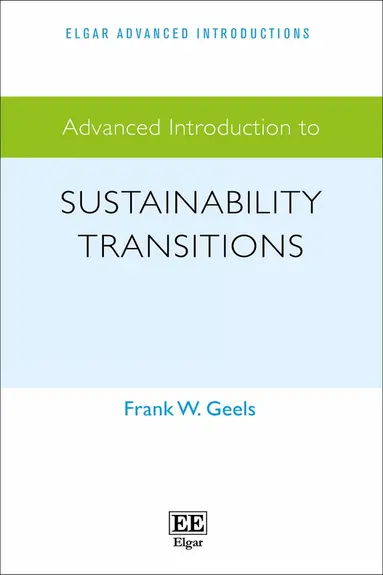
Advanced Introduction to Sustainability Transitions
296 krhos Bokus · exkl. frakt
103 kr skillnad mellan billigaste och dyraste butik i lager
Dubbelkollade priser
Jämför 3 butiker
- Bokus, 296 kr, frakt enligt butiken. Till butik (öppnas i ny flik)
I lagerFrakt: se butikenDubbelkollad 10:51
296 kr
Lägst
- Akademibokhandeln, 399 kr, frakt enligt butiken. Till butik (öppnas i ny flik)
I lagerFrakt: se butikenDubbelkollad 11:18
399 kr
- Adlibris, 296 kr, frakt enligt butiken. Till butik (öppnas i ny flik)
Slut i lagerFrakt: se butikenDubbelkollad 27 okt. 09:10
296 kr


Priser från butikernas flöden kan ha ändrats: det är priset hos butiken som gäller, så kontrollera det innan du handlar.
Prishistorik
Köp nu eller vänta?
Just nu kostar produkten 296 kr — 12 kr över det lägsta vi sett på 1 månad.
Under den tiden har det oftast legat runt 280–300 kr.
Pris idag
296 kr
- Lägst
- 284 kr
- Snitt
- 288 kr
- Högst
- 296 kr
| 2026-09-15 | 284 kr · Lägst hos Bokus |
|---|---|
| 2026-10-03 | 296 kr · Lägst hos Bokus |
| 2026-10-12 | 284 kr · Lägst hos Bokus |
| 2026-10-17 | 296 kr · Lägst hos Bokus |
| 2026-10-21 | 284 kr · Lägst hos Bokus |
| 2026-10-29 | 296 kr · Lägst hos Bokus |
Om produkten
Advanced Introduction to Sustainability Transitions
Läs merLäs mindre
Elgar Advanced Introductions are stimulating and thoughtful introductions to major fields in the social sciences, business and law, expertly written by the world's leading scholars. Designed to be accessible yet rigorous, they offer concise and lucid surveys of the substantive academic and policy issues associated with discrete subject areas.Frank W. Geels provides an insightful and evidenced introduction to one of the most important and dynamic topics in contemporary debates on how to address grand challenges like climate change and biodiversity loss.This book outlines current theories and research avenues in the rapidly growing field of sustainability transitions. Using a diverse range of empirical case studies, it emphasises the role of green innovations in relation to business, user, political, and cultural contexts in situated energy, mobility, and food systems. To capture this, the book shows how insights from mainstream disciplines have been integrated into the multi-level perspective, which has become the field's central middle-range conceptual framework.Written in an accessible style, this Advanced Introduction is vital for students and scholars of development economics, innovation, environmental politics and policy, sustainability studies and human geography.Key Features:Interdisciplinary in scopeDiscusses essential characteristics, theories, frameworks and actors of sustainability transitionsCovers topics including incumbent firm resistance and reorientation, the role of the state, policy instrument mixes and policymaking processes, social justice, grassroots innovation, consumption, emerging economies and geopolitics