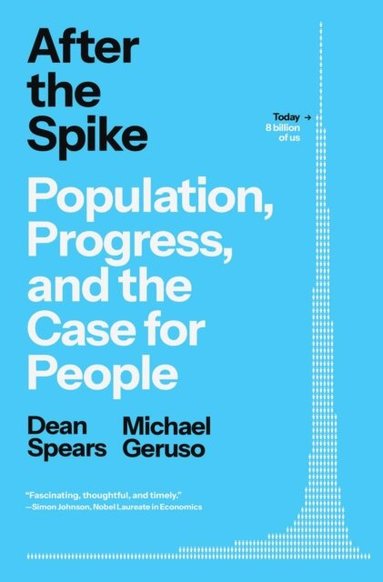
After the Spike
Dubbelkollade priser
Jämför 1 butik
- Bokus, 199 kr, frakt enligt butiken. Till butik (öppnas i ny flik)
I lagerFrakt: se butikenDubbelkollad 16 okt. 23:51
199 kr
Lägst

Priser från butikernas flöden kan ha ändrats: det är priset hos butiken som gäller, så kontrollera det innan du handlar.
Prishistorik
Köp nu eller vänta?
Pris idag
199 kr
- Lägst
- 196 kr
- Snitt
- 197 kr
- Högst
- 199 kr
| 2026-10-03 | 196 kr · Lägst hos Bokus |
|---|---|
| 2026-10-13 | 199 kr · Lägst hos Bokus |
Om produkten
After the Spike
Läs merLäs mindre
What if the challenge for humanity's future is not too many people on a crowded planet, but too few people to sustain the progress that the world needs? Most people on Earth today live in a country where birth rates already are too low to stabilize the population: fewer than two children for every two adults. In After the Spike, economists Dean Spears and Michael Geruso sound a wakeup call, explaining why global depopulation is coming, why it matters, and what to do now. It would be easy to think that fewer people would be better-better for the planet, better for the people who remain. This book invites us all to think again. Despite what we may have been told, depopulation is not the solution we urgently need for environmental challenges like climate change. Nor will it raise living standards by dividing what the world can offer across fewer of us. Spears and Geruso investigate what depopulation would mean for the climate, for living standards, for equity, for progress, for freedom, for humanity's general welfare. And what it would mean if, instead, people came together to share the work of caregiving and of building societies where parenting fits better with everything else that people aspire to. With new evidence and sharp insights, Spears and Geruso make a lively and compelling case for stabilizing the population-without sacrificing our dreams of a greener future or reverting to past gender inequities. They challenge us to see how depopulation threatens social equity and material progress, and how welcoming it denies the inherent value of every human life. More than an assembly of the most important facts, After the Spike asks what future we should want for our planet, for our children, and for one another.