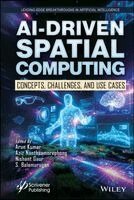
AI-Driven Spatial Computing
2 406 krhos Bokus · exkl. frakt
713 kr skillnad mellan billigaste och dyraste butik i lager
Dubbelkollat idag
Jämför 2 butiker
- Bokus, 2 406 kr, frakt enligt butiken. Till butik (öppnas i ny flik)
I lagerFrakt: se butikenDubbelkollad 14:51
2 406 kr
Lägst
- Akademibokhandeln, 3 119 kr, frakt enligt butiken. Till butik (öppnas i ny flik)
I lagerFrakt: se butikenDubbelkollad 14:53
3 119 kr

Priser från butikernas flöden kan ha ändrats: det är priset hos butiken som gäller, så kontrollera det innan du handlar.
Prishistorik
Köp nu eller vänta?
Just nu kostar produkten 2 406 kr — 27 kr över det lägsta vi sett på 3 veckor.
Under den tiden har det oftast legat runt 2 380–2 410 kr.
Pris idag
2 406 kr
- Lägst
- 2 379 kr
- Snitt
- 2 428 kr
- Högst
- 3 089 kr
| 2026-09-25 | 3 089 kr · Lägst hos Akademibokhandeln |
|---|---|
| 2026-09-26 | 2 379 kr · Lägst hos Bokus |
| 2026-09-30 | 2 381 kr · Lägst hos Bokus |
| 2026-10-02 | 2 396 kr · Lägst hos Bokus |
| 2026-10-03 | 2 398 kr · Lägst hos Bokus |
| 2026-10-04 | 2 407 kr · Lägst hos Bokus |
| 2026-10-05 | 2 410 kr · Lägst hos Bokus |
| 2026-10-10 | 2 407 kr · Lägst hos Bokus |
| 2026-10-12 | 2 392 kr · Lägst hos Bokus |
| 2026-10-16 | 2 406 kr · Lägst hos Bokus |
Om produkten
AI-Driven Spatial Computing
Läs merLäs mindre
Discover how the fusion of real-time adaptive AI and spatial computing is redefining Industry 5.0, giving you the exact technical frameworks and actionable strategies needed to lead the next era of human-machine innovation. Industries are increasingly leveraging automation and cutting-edge innovations to streamline operations and meet evolving demands. Today, Industry 5.0 emphasizes collaboration between humans and machines, enabling greater creativity, customization, and innovation. This volume explores a significant advancement in artificial intelligence: adaptive, AI-driven systems capable of learning and evolving in real time. Unlike traditional AI, which relies on static data and predefined models, adaptive AI responds dynamically to changing conditions, making it especially valuable in complex, unpredictable environments. This book explores the transformative fusion of artificial intelligence with spatial computing technologies, providing a comprehensive understanding of how intelligent systems interpret, interact with, and simulate physical environments. It presents a cohesive framework that demonstrates how AI augments spatial awareness and decision-making in complex, dynamic settings, delving into critical technical and ethical issues that arise from integrating AI into spatial systems. These include concerns about data privacy and surveillance, algorithmic bias in location-based services, the computational complexity of real-time 3D perception, and the lack of standardized platforms for interoperability across spatial devices. The text also examines infrastructure constraints such as bandwidth limitations, latency in edge processing, and the security vulnerabilities of AI-driven spatial networks. Each case study illustrates the tangible benefits of spatial intelligence, providing readers with actionable insights into emerging opportunities and strategic implementations in this rapidly evolving field. Readers will find the volume: Serves as a pioneering resource at the intersection of artificial intelligence and spatial technologies;Provides a timely synthesis of how AI techniques can enhance spatial awareness, decision-making, and interactivity in physical and virtual environments;Contributes to the maturation of spatial computing as an AI-augmented field, bringing together geoinformatics, robotics, and data science;Emphasizes technological integration and methodological and ethical frameworks needed for sustainable innovation.Audience Engineers, research scholars and students, IT professionals, network administrators, artificial intelligence and deep learning experts, and government research aagencies looking to the future AI applications.