Dubbelkollade priser
Jämför 2 butiker
- Bokus, 151 kr, frakt enligt butiken. Till butik (öppnas i ny flik)
I lagerFrakt: se butikenDubbelkollad 04:51
151 kr
Lägst
- Adlibris, 161 kr plus 35 kr frakt. Till butik (öppnas i ny flik)
Slut i lagerFrakt 35 krDubbelkollad 27 okt. 09:10
161 kr


Priser från butikernas flöden kan ha ändrats: det är priset hos butiken som gäller, så kontrollera det innan du handlar.
Prishistorik
Köp nu eller vänta?
Just nu kostar produkten 151 kr — 3 kr över det lägsta vi sett på 1 månad.
Under den tiden har det oftast legat runt 150 kr.
Pris idag
151 kr
- Lägst
- 148 kr
- Snitt
- 152 kr
- Högst
- 161 kr
| 2026-09-15 | 148 kr · Lägst hos Bokus |
|---|---|
| 2026-09-30 | 160 kr · Lägst hos Bokus |
| 2026-10-08 | 161 kr · Lägst hos Adlibris |
| 2026-10-10 | 151 kr · Lägst hos Bokus |
Om produkten
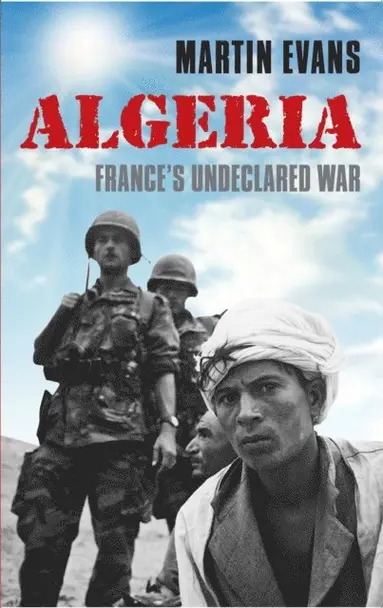
Algeria
Läs merLäs mindre
Invaded in 1830, populated by one million settlers who co-existed uneasily with nine million Arabs and Berbers, Algeria was different from other French colonies because it was administered as an integral part of France, in theory no different from Normandy or Brittany. The depth and scale of the colonization process explains why the Algerian War of 1954 to 1962 was one of the longest and most violent of the decolonization struggles. An undeclared war in the sense that there was no formal beginning of hostilities, the conflict produced huge tensions that brought down four governments, ended the Fourth Republic in 1958, and mired the French army in accusations of torture and mass human rights abuses. In carefully re-examining the origins and consequences of the conflict, Martin Evans argues that it was the Socialist-led Republican Front, in power from January 1956 until May 1957, which was the defining moment in the war, rather than the later administration under De Gaulle. Predicated on the belief in the universal civilizing mission of the Fourth Republic, coupled with the conviction that Algerian nationalism was feudal and religiously fanatical in character, the Republican Front dramatically intensified the war in the spring of 1956. Drawing upon previously classified archival sources as well as new oral testimonies, France''s Undeclared War is the first major English-language history of the Algerian conflict in a generation. Throughout, Martin Evans underlines the ultimately irreconcilable conflict of values between the Republican Front and Algerian nationalism, explaining how this clash produced patterns of thought and action, such as the institutionalization of torture and the raising of pro-French Muslim militias, which tragically polarized choices and framed all stages of the conflict.