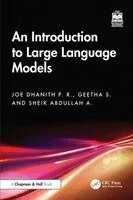
An Introduction to Large Language Models
808 krhos Bokus · exkl. frakt
241 kr skillnad mellan billigaste och dyraste butik i lager
Dubbelkollat idag
Jämför 2 butiker
- Bokus, 808 kr, frakt enligt butiken. Till butik (öppnas i ny flik)
I lagerFrakt: se butikenDubbelkollad 15:51
808 kr
Lägst
- Akademibokhandeln, 1 049 kr, frakt enligt butiken. Till butik (öppnas i ny flik)
I lagerFrakt: se butikenDubbelkollad 15:53
1 049 kr

Priser från butikernas flöden kan ha ändrats: det är priset hos butiken som gäller, så kontrollera det innan du handlar.
Prishistorik
Köp nu eller vänta?
Pris idag
808 kr
- Lägst
- 805 kr
- Snitt
- 806 kr
- Högst
- 808 kr
| 2026-10-11 | 808 kr · Lägst hos Bokus |
|---|---|
| 2026-10-12 | 805 kr · Lägst hos Bokus |
| 2026-10-16 | 808 kr · Lägst hos Bokus |
Om produkten
An Introduction to Large Language Models
Läs merLäs mindre
The book offers an introduction to large language models (LLMs) that bridge foundational natural language processing (NLP) concepts with the advanced techniques underlying large language models. It offers a structured exploration of NLP evolution, from rule- based approaches to transformer architectures. Covering key principles such as tokenization, attention mechanisms, and model architectures (BERT, GPT, T5), the book explains pretraining objectives like masked and causal language modeling. It also addresses optimization techniques such as LoRA, pruning, and quantization for efficient LLM deployment. Multimodal models, including GPT- 4 and PaLM- E, are explored alongside retrieval- augmented generation and AI- powered agents. Features: • Discusses foundational NLP concepts, theoretical depth, advanced techniques, and real- world applications. • Covers perplexity, BLEU, ROUGE, and datasets like SuperGLUE and SQuAD for assessing LLM performance, discusses LoRA, pruning, and quantization to optimize LLM deployment in resource- constrained settings. • Explores GPT- 4, PaLM- E, and retrieval- augmented generation, expanding beyond traditional NLP models. • Provides Python implementations for fine- tuning, classification, summarization, and conversational AI tasks. • Highlights use cases in text generation, code generation, sentiment analysis, and multimodal AI. This book is an invaluable textbook for students, researchers, and industry professionals seeking a deep technical understanding of LLMs and their applications.