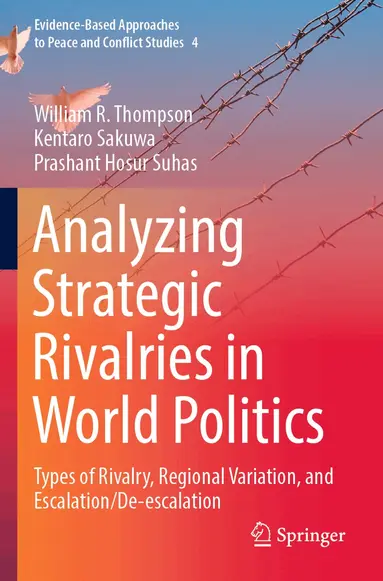
Analyzing Strategic Rivalries in World Politics
- Vikt 0,46 kg
732 krhos Bokus · exkl. frakt
217 kr skillnad mellan billigaste och dyraste butik i lager
Dubbelkollat idag
Jämför 2 butiker
- Bokus, 732 kr, frakt enligt butiken. Till butik (öppnas i ny flik)
I lagerFrakt: se butikenDubbelkollad 10:51
732 kr
Lägst
- Akademibokhandeln, 949 kr, frakt enligt butiken. Till butik (öppnas i ny flik)
I lagerFrakt: se butikenDubbelkollad 09:53
949 kr

Priser från butikernas flöden kan ha ändrats: det är priset hos butiken som gäller, så kontrollera det innan du handlar.
Prishistorik
Köp nu eller vänta?
Just nu kostar produkten 732 kr — 16 kr över det lägsta vi sett på 1 månad.
Pris idag
732 kr
- Lägst
- 716 kr
- Snitt
- 723 kr
- Högst
- 732 kr
| 2026-09-15 | 716 kr · Lägst hos Bokus |
|---|---|
| 2026-10-12 | 732 kr · Lägst hos Bokus |
Om produkten
Analyzing Strategic Rivalries in World Politics
Läs merLäs mindre
Strategic rivalries are contests between states that view one another as threatening competitors and treat each other as enemies. A disproportionate amount of interstate conflict is generated by a relatively small number of these pairs of states engaged in rivalries that can persist for years. Thus, to understand interstate peace and conflict, it is useful to know how rivalries work in general and more specifically. In the past two decades, a strenuous effort has been mounted to introduce the concept of rivalry and demonstrate its utility in unraveling conflict situations. Yet all rivalries are not exactly alike. We need to move to a more rewarding differentiation of how they differ in general. Principal rivalries are those antagonisms that are most significant to the decision makers in a state. The main distinction on issues about which rivals dispute are positional and spatial concerns. Positional rivalries contend over regional and global influence. Spatial rivals contend over which state deserves to control disputed territory. Interventionary rivalries predominate in sub-Saharan Africa. Their primary focus involves neighboring states attempting to influence who rules and how co-ethnics are treated. This book updates the inventory of strategic rivalries from 1816 to 2020. Principal rivalries are identified for the first time and cover the same period. A theory stressing the two main types of rivalry (positional and spatial) is elaborated and tested. Regional variations on the origins and terminations of spatial rivalry are explored and interpreted. In addition, attention is paid to fluctuations in the intensity of positional rivalries by examining the working of the contemporary major power triangle (United States, Soviet Union/Russia, and China) and, more generally, the dynamics of regional power that are rising in terms of their relative capability and status in the system. Variations in cooperation and termination dynamics both in general andaccording to rivalry type are also examined. Overall, the emphases of the book are split between demonstrating the utility of distinguishing among rivalry types and examining selected rivalry dynamics.
Specifikationer
Fakta
- Vikt
- 0,46 kg
- GTIN
- 09789811666735
Uppgifter från tillverkare och butiker.