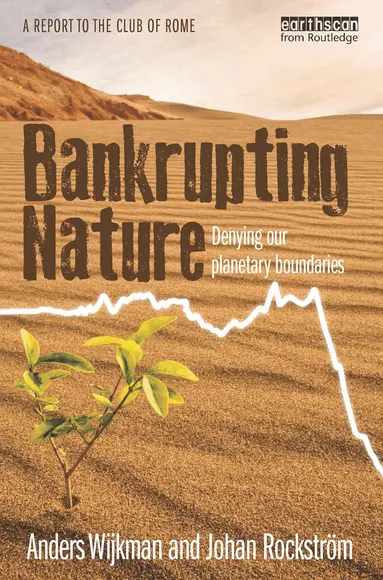
Bankrupting Nature
- Vikt 0,45 kg
761 krhos Bokus · exkl. frakt
228 kr skillnad mellan billigaste och dyraste butik i lager
Dubbelkollade priser
Jämför 3 butiker
- Bokus, 761 kr, frakt enligt butiken. Till butik (öppnas i ny flik)
I lagerFrakt: se butikenDubbelkollad 14:51
761 kr
Lägst
- Akademibokhandeln, 989 kr, frakt enligt butiken. Till butik (öppnas i ny flik)
I lagerFrakt: se butikenDubbelkollad 14:53
989 kr
- Adlibris, 685 kr, frakt enligt butiken. Till butik (öppnas i ny flik)
Slut i lagerFrakt: se butikenDubbelkollad 27 okt. 09:10
685 kr


Priser från butikernas flöden kan ha ändrats: det är priset hos butiken som gäller, så kontrollera det innan du handlar.
Prishistorik
Köp nu eller vänta?
Just nu kostar produkten 761 kr — 76 kr över det lägsta vi sett på 1 månad.
Under den tiden har det oftast legat runt 690–770 kr.
Pris idag
761 kr
- Lägst
- 685 kr
- Snitt
- 726 kr
- Högst
- 765 kr
| 2026-09-15 | 685 kr · Lägst hos Adlibris |
|---|---|
| 2026-10-04 | 740 kr · Lägst hos Bokus |
| 2026-10-05 | 685 kr · Lägst hos Adlibris |
| 2026-10-08 | 740 kr · Lägst hos Bokus |
| 2026-10-10 | 764 kr · Lägst hos Bokus |
| 2026-10-11 | 762 kr · Lägst hos Bokus |
| 2026-10-17 | 765 kr · Lägst hos Bokus |
| 2026-10-31 | 761 kr · Lägst hos Bokus |
Om produkten
Bankrupting Nature
Läs merLäs mindre
This powerful book shows us that we are in deep denial about the magnitude of the global environmental challenges and resource constraints facing the world. Despite growing scientific consensus on major environmental threats as well as resource depletion, societies are largely continuing with business as usual, at best attempting to tinker at the margins of the problems. The authors argue that regardless of whether governments respond to the economic crisis through additional stimulus packages or reduced government spending, environmental and resource constraints will remain. The crisis will be exacerbated by the combination of climate change, ecosystem decline and resource scarcity, in particular crude oil. The concept of Planetary Boundaries is introduced as a powerful explanation of the limits of the biosphere to sustain continued conventional growth. The book breaks the long silence on population, criticizing donor countries for not doing enough to support the education of girls and reproductive health services. It is shown that an economy built on the continuous expansion of material consumption is not sustainable. De-growth, however, is no solution either. The growth dilemma can only be addressed through a transformation of the economic system. A strong plea is made for abandoning GDP growth as the key objective for development. The focus should instead be on a limited number of welfare indicators. The trickle-down concept is seriously questioned, to be replaced by one of sufficiency. Rich countries are called upon to hold back their material growth to leave room for a rising living standard among the poor. Alternative business models are presented, such as moving from products to services or towards a circular economy based on re-use, reconditioning and recylcing - all with the aim of facilitating sustainable development.A Report to the Club of Rome
Specifikationer
Fakta
- Vikt
- 0,45 kg
- GTIN
- 09780415539692
Uppgifter från tillverkare och butiker.