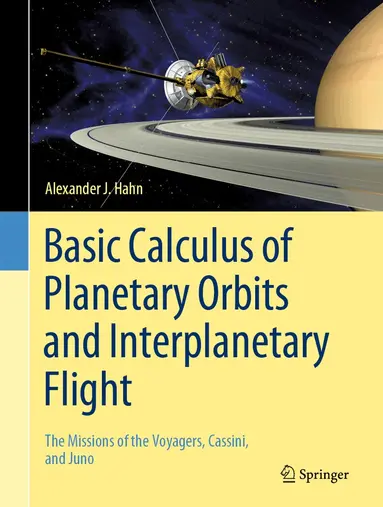
Basic Calculus of Planetary Orbits and Interplanetary Flight
- Vikt 1,41 kg
Bra pris nuLägsta priset på 1 månad
707 kr710 kr−0% senaste veckanhos Bokus · exkl. frakt
Jämfört med det lägsta pris vi sett de 30 dagarna före sänkningen.
212 kr skillnad mellan billigaste och dyraste butik i lager
Dubbelkollat idag
Jämför 2 butiker
- Bokus, 707 kr, frakt enligt butiken. Till butik (öppnas i ny flik)
I lagerFrakt: se butikenDubbelkollad 07:51
707 kr
Lägst
- Akademibokhandeln, 919 kr, frakt enligt butiken. Till butik (öppnas i ny flik)
I lagerFrakt: se butikenDubbelkollad 07:53
919 kr

Priser från butikernas flöden kan ha ändrats: det är priset hos butiken som gäller, så kontrollera det innan du handlar.
Prishistorik
Köp nu eller vänta?
Just nu kostar produkten 707 kr — det lägsta vi sett på 1 månad.
Under den tiden har det oftast legat runt 710–720 kr.
Pris idag
707 kr
- Lägst
- 707 kr
- Snitt
- 718 kr
- Högst
- 732 kr
| 2026-09-15 | 732 kr · Lägst hos Bokus |
|---|---|
| 2026-09-17 | 721 kr · Lägst hos Bokus |
| 2026-09-18 | 720 kr · Lägst hos Bokus |
| 2026-09-23 | 721 kr · Lägst hos Bokus |
| 2026-09-24 | 720 kr · Lägst hos Bokus |
| 2026-09-25 | 719 kr · Lägst hos Bokus |
| 2026-09-27 | 720 kr · Lägst hos Bokus |
| 2026-09-30 | 721 kr · Lägst hos Bokus |
| 2026-10-02 | 724 kr · Lägst hos Bokus |
| 2026-10-04 | 725 kr · Lägst hos Bokus |
| 2026-10-07 | 722 kr · Lägst hos Bokus |
| 2026-10-09 | 719 kr · Lägst hos Bokus |
| 2026-10-11 | 718 kr · Lägst hos Bokus |
| 2026-10-12 | 716 kr · Lägst hos Bokus |
| 2026-10-13 | 714 kr · Lägst hos Bokus |
| 2026-10-16 | 716 kr · Lägst hos Bokus |
| 2026-10-17 | 714 kr · Lägst hos Bokus |
| 2026-10-20 | 713 kr · Lägst hos Bokus |
| 2026-10-22 | 710 kr · Lägst hos Bokus |
| 2026-10-24 | 713 kr · Lägst hos Bokus |
| 2026-10-27 | 714 kr · Lägst hos Bokus |
| 2026-10-30 | 716 kr · Lägst hos Bokus |
| 2026-11-01 | 707 kr · Lägst hos Bokus |
Om produkten
Basic Calculus of Planetary Orbits and Interplanetary Flight
Läs merLäs mindre
Intended for a one- or two-semester course, this text applies basic, one-variable calculus to analyze the motion both of planets in their orbits as well as interplanetary spacecraft in their trajectories. The remarkable spacecraft missions to the inner and outermost reaches of our solar system have been one of the greatest success stories of modern human history. Much of the underlying mathematical story is presented alongside the astonishing images and extensive data that NASA's Voyager, NEAR-Shoemaker, Cassini, and Juno missions have sent back to us. First and second year college students in mathematics, engineering, or science, and those seeking an enriching independent study, will experience the mathematical language and methods of single variable calculus within their application to relevant conceptual and strategic aspects of the navigation of a spacecraft. The reader is expected to have taken one or two semesters of the basic calculus of derivatives, integrals, and the role that limits play. Additional prerequisites include knowledge of coordinate plane geometry, basic trigonometry, functions and graphs, including trig, inverse, exponential, and log functions.The discussions begin with the rich history of humanity's efforts to understand the universe from the Greeks, to Newton and the Scientific Revolution, to Hubble and galaxies, to NASA and the space missions. The calculus of polar functions that plays a central mathematical role is presented in a self-contained way in complete detail. Each of the six chapters is followed by an extensive problem set that deals with and also expands on the concerns of the chapter. The instructor has the flexibility to engage them with greater or lesser intensity."I have been an aerospace engineer for 39 years and honestly, it would be hard for me to overstate how valuable I believe this book will be to numerous scientific and engineering disciplines and in particular to the future of aerospace engineering ... This book is perfectly crafted to motivate, educate, and prepare the scientists and engineers who wish to reach for the sky and beyond." -Dr. Mario Zoccoli, Aerospace Engineer, NASA and Lockheed Martin
Specifikationer
Fakta
- Vikt
- 1,41 kg
- GTIN
- 09783030248673
Uppgifter från tillverkare och butiker.