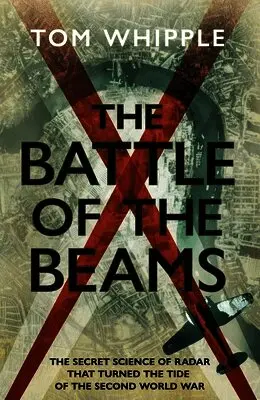
Battle of the Beams
- Vikt 0,53 kg
Dubbelkollat idag
Jämför 2 butiker
- Bokus, 249 kr, frakt enligt butiken. Till butik (öppnas i ny flik)
Slut i lagerFrakt: se butikenDubbelkollad 11:51
249 kr
- Akademibokhandeln, 319 kr, frakt enligt butiken. Till butik (öppnas i ny flik)
Slut i lagerFrakt: se butikenDubbelkollad 11:53
319 kr

Priser från butikernas flöden kan ha ändrats: det är priset hos butiken som gäller, så kontrollera det innan du handlar.
Prishistorik
Köp nu eller vänta?
- Lägst
- 242 kr
- Snitt
- 250 kr
- Högst
- 319 kr
| 2026-09-15 | 242 kr · Lägst hos Bokus |
|---|---|
| 2026-10-06 | 249 kr · Lägst hos Bokus |
| 2026-10-28 | 319 kr · Lägst hos Akademibokhandeln |
| 2026-10-31 | Ingen butik hade produkten i lager |
Om produkten
Battle of the Beams
Läs merLäs mindre
'Deeply researched and engagingly written' The Times'Has the pace and style of a well-crafted thriller' Mail on Sunday'Chock full of memorable characters and written with all the drama and pace of a Robert Harris thriller' Rowland White, author of Harrier 809The radio war of 1939-45 is one of the great scientific battles in history.This is the story of that war.Relying on first-hand accounts as well as papers recently released by the Admiralty, The Battle of the Beams fills a huge missing piece in the canon of WW2 literature.It combines history, science, derring do and dogged determination and will appeal as much to fans of WW2 history as to those fascinated by the science behind the beams that changed our lives.The British believed that, through ingenuity and scientific prowess, they alone have a war-winning weapon: radar. They are wrong. The Germans have it too.They believe that their unique maritime history means their pilots have no need of navigational aids. Flying above the clouds they, like the seafarers of old, had the stars to guide them, and that is all that is required. They are wrong. Most of the bombs the RAF will drop in the first years of the war land miles from their target.They also believe that the Germans, without the same naval tradition, will never be able to find targets at night. They are, again, wrong. In 1939 the Germans don't just have radar to spot planes entering their airspace, they have radio beams to guide their own planes into enemy airspace.Luckily there was one young engineer, Reginald Jones, helping the British government with their own scientific developments. In June 1940, when Jones quietly explained the beams the Germans had devised to a room full of disbelieving sceptics, Churchill later described the moment as like sitting in the parlour while Sherlock Holmes finally reveals the killer. Churchill immediately supported Jones's efforts to develop radar technology that went on to help the Allies win the war.
Specifikationer
Fakta
- Vikt
- 0,53 kg
- GTIN
- 09781787634138
Uppgifter från tillverkare och butiker.