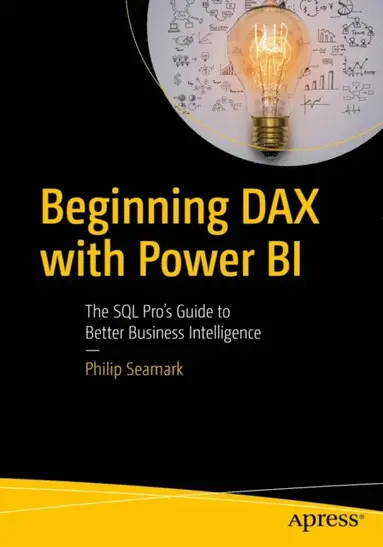
Beginning DAX with Power BI
Dubbelkollat idag
Jämför 1 butik
- Bokus, 923 kr, frakt enligt butiken. Till butik (öppnas i ny flik)
I lagerFrakt: se butikenDubbelkollad 12:51
923 kr
Lägst

Priser från butikernas flöden kan ha ändrats: det är priset hos butiken som gäller, så kontrollera det innan du handlar.
Prishistorik
Köp nu eller vänta?
Just nu kostar produkten 923 kr — 29 kr över det lägsta vi sett på 1 månad.
Pris idag
923 kr
- Lägst
- 894 kr
- Snitt
- 910 kr
- Högst
- 923 kr
| 2026-09-15 | 894 kr · Lägst hos Bokus |
|---|---|
| 2026-10-06 | 923 kr · Lägst hos Bokus |
Om produkten
Beginning DAX with Power BI
Läs merLäs mindre
Attention all SQL Pros, DAX is not just for writing Excel-based formulas! Get hands-on learning and expert advice on how to use the vast capabilities of the DAX language to solve common data modeling challenges. Beginning DAX with Power BI teaches key concepts such as mapping techniques from SQL to DAX, filtering, grouping, joining, pivoting, and using temporary tables, all aimed at the SQL professional. Join author Philip Seamark as he guides you on a journey through typical business data transformation scenarios and challenges, and teaches you, step-by-step, how to resolve challenges using DAX. Tips, tricks, and shortcuts are included and explained, along with examples of the SQL equivalent, in order to accelerate learning. Examples in the book range from beginner to advanced, with plenty of detailed explanation when walking through each scenario. What You'll Learn Turbocharge your Power BI model by adding advanced DAX programming techniquesKnow when to use calculated measures versus calculated columnsGenerate new tables on the fly from existing dataOptimize, monitor, and tune Power BI to improve performance of your modelsDiscover new ideas, tricks, and time-saving techniques for better models Who This Book Is For Business intelligence developers, business analysts, or any SQL user who wants to use Power BI as a reporting tool. A solid understanding of SQL is recommended, as examples throughout the book include the DAX equivalents to SQL problem/solution scenarios.