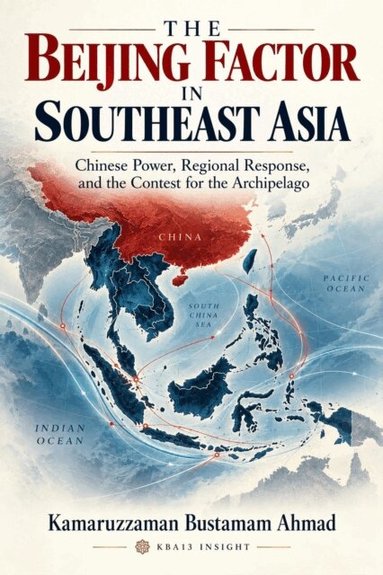
Beijing Factor in Southeast Asia: Chinese Power, Regional Response, and the Contest for the Archipelago
Dubbelkollade priser
Jämför 1 butik
- Bokus, 171 kr, frakt enligt butiken. Till butik (öppnas i ny flik)
I lagerFrakt: se butikenDubbelkollad 18 okt. 23:51
171 kr
Lägst

Priser från butikernas flöden kan ha ändrats: det är priset hos butiken som gäller, så kontrollera det innan du handlar.
Om produkten
Beijing Factor in Southeast Asia: Chinese Power, Regional Response, and the Contest for the Archipelago
Läs merLäs mindre
China's rise is reshaping Southeast Asia-but power does not automatically become control.Across the South China Sea, the Natuna Islands, critical-mineral processing zones, infrastructure corridors, digital networks, and global supply chains, Beijing has become an increasingly consequential presence in Southeast Asia. Yet the states of the region are not passive recipients of Chinese power.The Beijing Factor in Southeast Asia examines the interaction between China's expanding strategic reach and the choices made by Southeast Asian governments.Written from an Indonesian and archipelagic perspective, Kamaruzzaman Bustamam Ahmad challenges simplistic narratives of either inevitable Chinese domination or an emerging new Cold War. Instead, he shows how Indonesia, Vietnam, Malaysia, the Philippines, Singapore, Thailand, Cambodia, Laos, and other regional actors bargain, hedge, accommodate, resist, and diversify their relationships with competing powers.The book explores China's trade and investment relationships, the Belt and Road Initiative, critical minerals and downstream industrialization, the South China Sea, maritime coercion, ASEAN diplomacy, U.S.-China competition, tariffs and supply-chain restructuring, digital infrastructure, and the politics of knowledge and influence.Particular attention is given to Indonesia: the Natuna Islands, the strategic importance of the archipelago, and the growing difficulty of maintaining bebas-aktif-Indonesia's tradition of an independent and active foreign policy-in an increasingly polarized Indo-Pacific.At the center of the analysis is a crucial distinction:Presence is not the same as influence. Influence is not the same as control.Chinese economic weight can generate dependence without obedience, infrastructure without political alignment, and strategic pressure without compliance. Understanding contemporary Southeast Asia therefore requires examining not only what Beijing possesses, but what Chinese power can actually cause other states to do.Drawing on official documents, international law, economic evidence, scholarly research, and regional observation, Ahmad develops the concept of contested asymmetric multipolarity to explain an emerging regional order in which power is distributed unevenly, but political agency remains contested.The Beijing Factor in Southeast Asia is essential reading for readers interested in China, Southeast Asia, ASEAN, international relations, maritime security, political economy, Indo-Pacific geopolitics, and the changing global balance of power.