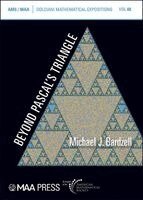
Beyond Pascal's Triangle
835 krhos Bokus · exkl. frakt
244 kr skillnad mellan billigaste och dyraste butik i lager
Dubbelkollat idag
Jämför 2 butiker
- Bokus, 835 kr, frakt enligt butiken. Till butik (öppnas i ny flik)
I lagerFrakt: se butikenDubbelkollad 14:51
835 kr
Lägst
- Akademibokhandeln, 1 079 kr, frakt enligt butiken. Till butik (öppnas i ny flik)
I lagerFrakt: se butikenDubbelkollad 14:53
1 079 kr

Priser från butikernas flöden kan ha ändrats: det är priset hos butiken som gäller, så kontrollera det innan du handlar.
Prishistorik
Köp nu eller vänta?
Pris idag
835 kr
- Lägst
- 835 kr
- Snitt
- 962 kr
- Högst
- 1 089 kr
| 2026-10-15 | 1 089 kr · Lägst hos Akademibokhandeln |
|---|---|
| 2026-10-16 | 835 kr · Lägst hos Bokus |
Om produkten
Beyond Pascal's Triangle
Läs merLäs mindre
Beautiful self-similar patterns emerge when the entries of Pascal's Triangle are reduced modulo a positive integer $n$. This book offers an engaging exploration of a natural extension of this idea: since the integers modulo $n$ form a finite group, what happens when we construct Pascal-like triangles over other finite groups? The book is organized into four parts. It begins with an introduction to the necessary background on Pascal's Triangle, with a strong emphasis on its visual aspects. The second part builds on these visual phenomena-referred to as PascGalois triangles-to explore concepts from finite group theory, combining pattern recognition with underlying algebraic structure. In the third part, the PascGalois triangles are shown to be instances of cellular automata, opening the door to an investigation of discrete dynamical systems. The final part examines the emergence of self-similarity and fractal geometry from these automata. Numerous student projects are included throughout to encourage further exploration, and the concluding chapter offers additional topics for extension. While much of the necessary background is developed within the text, readers will benefit from prior coursework in discrete mathematics and linear algebra, as well as some familiarity with mathematical proofs. No previous knowledge of group theory is assumed. The PascGalois software and other resources can be found at the Project webpage: https://faculty.salisbury.edu/~despickler/pascgalois/.