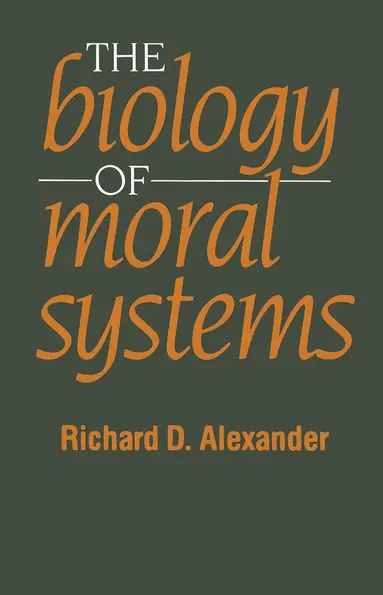
Biology of Moral Systems
- Vikt 0,5 kg
761 krhos Bokus · exkl. frakt
228 kr skillnad mellan billigaste och dyraste butik i lager
Dubbelkollade priser
Jämför 3 butiker
- Bokus, 761 kr, frakt enligt butiken. Till butik (öppnas i ny flik)
I lagerFrakt: se butikenDubbelkollad 14:51
761 kr
Lägst
- Akademibokhandeln, 989 kr, frakt enligt butiken. Till butik (öppnas i ny flik)
I lagerFrakt: se butikenDubbelkollad 14:53
989 kr
- Adlibris, 632 kr, frakt enligt butiken. Till butik (öppnas i ny flik)
Slut i lagerFrakt: se butikenDubbelkollad 27 okt. 09:10
632 kr


Priser från butikernas flöden kan ha ändrats: det är priset hos butiken som gäller, så kontrollera det innan du handlar.
Prishistorik
Köp nu eller vänta?
Just nu kostar produkten 761 kr — 129 kr över det lägsta vi sett på 1 månad.
Under den tiden har det oftast legat runt 630–660 kr.
Pris idag
761 kr
- Lägst
- 632 kr
- Snitt
- 672 kr
- Högst
- 769 kr
| 2026-09-15 | 632 kr · Lägst hos Adlibris |
|---|---|
| 2026-10-04 | 649 kr · Lägst hos Bokus |
| 2026-10-05 | 632 kr · Lägst hos Adlibris |
| 2026-10-08 | 659 kr · Lägst hos Bokus |
| 2026-10-10 | 767 kr · Lägst hos Bokus |
| 2026-10-11 | 764 kr · Lägst hos Bokus |
| 2026-10-12 | 659 kr · Lägst hos Bokus |
| 2026-10-13 | 649 kr · Lägst hos Bokus |
| 2026-10-16 | 659 kr · Lägst hos Bokus |
| 2026-10-17 | 764 kr · Lägst hos Bokus |
| 2026-10-21 | 659 kr · Lägst hos Bokus |
| 2026-10-22 | 649 kr · Lägst hos Bokus |
| 2026-10-24 | 659 kr · Lägst hos Bokus |
| 2026-10-27 | 767 kr · Lägst hos Bokus |
| 2026-10-28 | 769 kr · Lägst hos Bokus |
| 2026-10-30 | 766 kr · Lägst hos Bokus |
| 2026-11-01 | 761 kr · Lägst hos Bokus |
Om produkten
Biology of Moral Systems
Läs merLäs mindre
Despite wide acceptance that the attributes of living creatures have appeared through a cumulative evolutionary process guided chiefly by natural selection, many human activities have seemed analytically inaccessible through such an approach. Prominent evolutionary biologists, for example, have described morality as contrary to the direction of biological evolution, and moral philosophers rarely regard evolution as relevant to their discussions.The Biology of Moral Systems adopts the position that moral questions arise out of conflicts of interest, and that moral systems are ways of using confluences of interest at lower levels of social organization to deal with conflicts of interest at higher levels. Moral systems are described as systems of indirect reciprocity: humans gain and lose socially and reproductively not only by direct transactions, but also by the reputations they gain from the everyday flow of social interactions.The author develops a general theory of human interests, using senescence and effort theory from biology, to help analyze the patterning of human lifetimes. He argues that the ultimate interests of humans are reproductive, and that the concept of morality has arisen within groups because of its contribution to unity in the context, ultimately, of success in intergroup competition. He contends that morality is not easily relatable to universals, and he carries this argument into a discussion of what he calls the greatest of all moral problems, the nuclear arms race."Crammed with sage observations on moral dilemmas and many reasons why an understanding of evolution based on natural selection will advance thinking in finding practical solutions to our most difficult social problems." û Annals of the American Academy of Political and Social Sciences Richard D. Alexander is Donald Ward Tinkle Professor of Evolutionary Biology, Department of Biology, and Curator of Insects, Museum of Zoology, University of Michigan. A recipient of numerous awards, Dr. Alexander is the author of Darwinism and Human Affairs.
Specifikationer
Fakta
- Vikt
- 0,5 kg
- GTIN
- 09780202011745
Uppgifter från tillverkare och butiker.