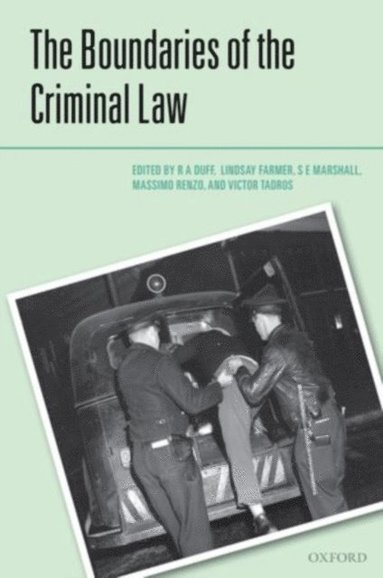
Boundaries of the Criminal Law
Dubbelkollat idag
Jämför 1 butik
- Bokus, 1 060 kr, frakt enligt butiken. Till butik (öppnas i ny flik)
I lagerFrakt: se butikenDubbelkollad 11:51
1 060 kr
Lägst

Priser från butikernas flöden kan ha ändrats: det är priset hos butiken som gäller, så kontrollera det innan du handlar.
Prishistorik
Köp nu eller vänta?
Just nu kostar produkten 1 060 kr — 417 kr över det lägsta vi sett på 2 veckor.
Under den tiden har det oftast legat runt 640–1 060 kr.
Pris idag
1 060 kr
- Lägst
- 643 kr
- Snitt
- 797 kr
- Högst
- 1 060 kr
| 2026-09-30 | 643 kr · Lägst hos Bokus |
|---|---|
| 2026-10-11 | 657 kr · Lägst hos Bokus |
| 2026-10-12 | 1 060 kr · Lägst hos Bokus |
Om produkten
Boundaries of the Criminal Law
Läs merLäs mindre
Criminalization is a new series arising from an interdisciplinary investigation into criminalization, focussing on the principles and goals that should guide decisions about what kinds of conduct are to be criminalized, and the forms that criminalization should take. Developing a normative theory of criminalization, the six volumes will tackle the key questions at the heart of issue: By reference to what principles and goals should legislations decide what to criminalize? How should criminal wrongs be classified and differentiated? And how should law enforcement officials apply the law''s specification of offences?Boundaries of the Criminal Law is the first book in this series examining the scope and boundaries of the criminal law. Investigations into the scope of the criminal law have often focused on the harm principle, the principle that conduct can be justifiably criminalized only if it is harmful, or other master principles that might determine the proper scope of the criminal law. This collection of original essays by some of the leading scholars in criminal law and philosophy from the UK and the US makes significant advances in the development of a broader range of ideas that might inform criminalization decisions. A range of issues are discussed, including the significance for criminalization of ideas of moral wrongdoing and of using a person as a means, the distinction between criminal law and other forms of legal regulation, the role of new technology in our understanding of the evolving scope of the criminal law, and the role of criminal justice officials in decision-making about criminalization. The authors draw on legal and philosophical sources, but also on history, sociology and social psychology in their investigations for a truly interdisciplinary approach. This is a groundbreaking set of essays which will help to reorient legal and philosophical discussion about the proper scope of the criminal law.