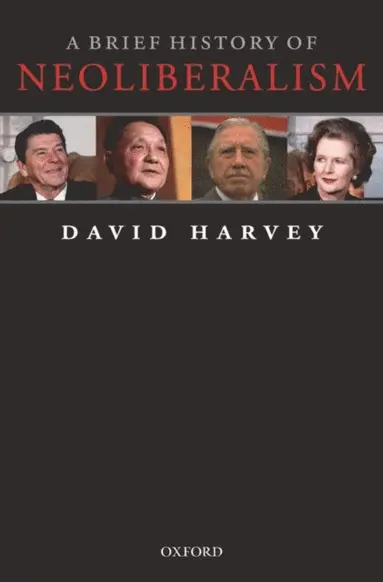
Brief History of Neoliberalism
Dubbelkollade priser
Jämför 2 butiker
- Bokus, 149 kr, frakt enligt butiken. Till butik (öppnas i ny flik)
I lagerFrakt: se butikenDubbelkollad 05:51
149 kr
Lägst
- Adlibris, 159 kr plus 35 kr frakt. Till butik (öppnas i ny flik)
Slut i lagerFrakt 35 krDubbelkollad 27 okt. 09:10
159 kr


Priser från butikernas flöden kan ha ändrats: det är priset hos butiken som gäller, så kontrollera det innan du handlar.
Prishistorik
Köp nu eller vänta?
Just nu kostar produkten 149 kr — 4 kr över det lägsta vi sett på 1 månad.
Under den tiden har det oftast legat runt 150–160 kr.
Pris idag
149 kr
- Lägst
- 145 kr
- Snitt
- 154 kr
- Högst
- 159 kr
| 2026-09-15 | 157 kr · Lägst hos Bokus |
|---|---|
| 2026-09-17 | 145 kr · Lägst hos Bokus |
| 2026-09-19 | 159 kr · Lägst hos Bokus |
| 2026-09-27 | 145 kr · Lägst hos Bokus |
| 2026-09-30 | 159 kr · Lägst hos Bokus |
| 2026-10-10 | 145 kr · Lägst hos Bokus |
| 2026-10-12 | 159 kr · Lägst hos Bokus |
| 2026-10-15 | 149 kr · Lägst hos Bokus |
| 2026-10-21 | 159 kr · Lägst hos Bokus |
| 2026-10-26 | 149 kr · Lägst hos Bokus |
Om produkten
Brief History of Neoliberalism
Läs merLäs mindre
Neoliberalism - the doctrine that market exchange is an ethic in itself, capable of acting as a guide for all human action - has become dominant in both thought and practice throughout much of the world since 1970 or so.Its spread has depended upon a reconstitution of state powers such that privatization, finance, and market processes are emphasized. State interventions in the economy are minimized, while the obligations of the state to provide for the welfare of its citizens are diminished. David Harvey, author of ''The New Imperialism'' and ''The Condition of Postmodernity'', here tells the political-economic story of where neoliberalization came from and how it proliferated on the world stage. While Thatcherand Reagan are often cited as primary authors of this neoliberal turn, Harvey shows how a complex of forces, from Chile to China and from New York City to Mexico City, have also played their part. In addition he explores the continuities and contrasts between neoliberalism of the Clinton sort and therecent turn towards neoconservative imperialism of George W. Bush. Finally, through critical engagement with this history, Harvey constructs a framework not only for analyzing the political and economic dangers that now surround us, but also for assessing the prospects for the more socially just alternatives being advocated by many oppositional movements.