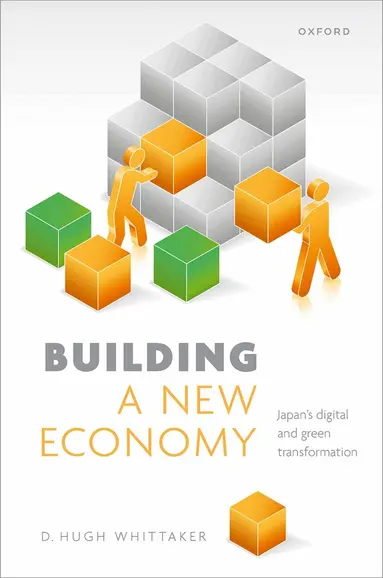
Building a New Economy
- Vikt 0,56 kg
1 476 krhos Bokus · exkl. frakt
443 kr skillnad mellan billigaste och dyraste butik i lager
Dubbelkollat idag
Jämför 2 butiker
- Bokus, 1 476 kr, frakt enligt butiken. Till butik (öppnas i ny flik)
I lagerFrakt: se butikenDubbelkollad 13:51
1 476 kr
Lägst
- Akademibokhandeln, 1 919 kr, frakt enligt butiken. Till butik (öppnas i ny flik)
I lagerFrakt: se butikenDubbelkollad 13:53
1 919 kr

Priser från butikernas flöden kan ha ändrats: det är priset hos butiken som gäller, så kontrollera det innan du handlar.
Prishistorik
Köp nu eller vänta?
Just nu kostar produkten 1 476 kr — 32 kr över det lägsta vi sett på 1 månad.
Pris idag
1 476 kr
- Lägst
- 1 444 kr
- Snitt
- 1 464 kr
- Högst
- 1 476 kr
| 2026-09-15 | 1 444 kr · Lägst hos Bokus |
|---|---|
| 2026-10-03 | 1 476 kr · Lägst hos Bokus |
Om produkten
Japan is attempting to build a new economy
Läs merLäs mindre
It goes by various names, such as 'Society 5.0', 'sustainable capitalism', and 'new form of capitalism'. It is to be constructed through digital and green transformation, and a 'virtuous cycle of growth and distribution'. The effort faces strong headwinds, including demographic decline and ageing, Japan's external energy dependence and geopolitical turbulence, and the legacies of Japan's 'lost decades'. Nonetheless, since 2015 a path has been identified that steers between Big Tech market oligopoly on the one hand, and an overbearing state on the other. For others facing the same post-neoliberal, sustainability transformation challenges as Japan, this public-private coordinated building effort is noteworthy.Building a New Economy uses an evolutionary conceptual framework of states-and-markets, organizations-and-technology, and institutional change. It shows how the institutional coherence of the manufacturing-centred postwar model broke down, and was followed by the ideological and institutional dissonance of the 'lost decades'. However, new institutional building blocks have been identified and (partially) assembled which could lead Japan towards a new model which is more open and adaptive. These blocks include a reconfigured developmental state, and new forms of coordination with and within the corporate sector, at times encompassing civil society.Importantly, for a country that has favoured social stability over creative destruction, and has struggled with change, the path forward may require 'controlled dis-equilibrium' of institutions rather than tight coherence. 'Society 5.0' and the 'new form of capitalism' claim to be people-centred; making them so will be the crucial challenge.
Specifikationer
Fakta
- Vikt
- 0,56 kg
- GTIN
- 09780198893394
Uppgifter från tillverkare och butiker.