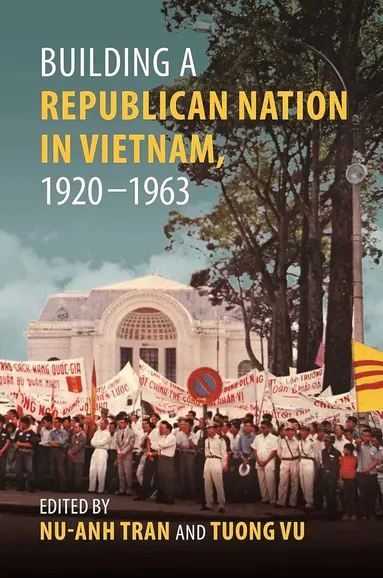
Building a Republican Nation in Vietnam, 1920-1963
- Vikt 0,27 kg
311 krhos Bokus · exkl. frakt
98 kr skillnad mellan billigaste och dyraste butik i lager
Dubbelkollat idag
Jämför 2 butiker
- Bokus, 311 kr, frakt enligt butiken. Till butik (öppnas i ny flik)
I lagerFrakt: se butikenDubbelkollad 19:51
311 kr
Lägst
- Akademibokhandeln, 409 kr, frakt enligt butiken. Till butik (öppnas i ny flik)
I lagerFrakt: se butikenDubbelkollad 19:53
409 kr

Priser från butikernas flöden kan ha ändrats: det är priset hos butiken som gäller, så kontrollera det innan du handlar.
Prishistorik
Köp nu eller vänta?
Just nu kostar produkten 311 kr — 6 kr över det lägsta vi sett på 1 månad.
Under den tiden har det oftast legat runt 310 kr.
Pris idag
311 kr
- Lägst
- 305 kr
- Snitt
- 309 kr
- Högst
- 312 kr
| 2026-09-15 | 305 kr · Lägst hos Bokus |
|---|---|
| 2026-09-18 | 309 kr · Lägst hos Bokus |
| 2026-09-19 | 308 kr · Lägst hos Bokus |
| 2026-09-25 | 307 kr · Lägst hos Bokus |
| 2026-10-02 | 309 kr · Lägst hos Bokus |
| 2026-10-03 | 310 kr · Lägst hos Bokus |
| 2026-10-04 | 311 kr · Lägst hos Bokus |
| 2026-10-09 | 310 kr · Lägst hos Bokus |
| 2026-10-12 | 309 kr · Lägst hos Bokus |
| 2026-10-16 | 310 kr · Lägst hos Bokus |
| 2026-10-28 | 312 kr · Lägst hos Bokus |
| 2026-10-29 | 311 kr · Lägst hos Bokus |
Om produkten
Building a Republican Nation in Vietnam, 1920-1963
Läs merLäs mindre
Western observers have long considered communism to be synonymous with Vietnam's modern historical experience. Eager to make sense of the North Vietnamese victory in the Vietnam War, scholars and journalists have spilled much ink on the history of Vietnamese communists. But this preoccupation has obscured the diversity of ideas and experiences that defined Vietnam in the twentieth century, in which communism represented just one of many tendencies. Building a Republican Nation in Vietnam, 1920-1963, posits that republicanism shaped modern Vietnam no less profoundly than communism. Republicans championed representative government, the universal rights of man, civil liberties, and the primacy of the nation. These ideas infused the thinking of Vietnamese reformers, dissidents, and revolutionaries from the 1900s onward, including many men and women who went on to lead the struggle for independence. Republicanism was also one of the chief inspirations for the establishment of the Republic of Vietnam (also known as South Vietnam) in 1955.This interdisciplinary volume brings together eleven essays by historians, political scientists, literary scholars, and sociologists, who make use of fresh sources to study the development of republicanism from the colonial period to the First Republic of Vietnam (1955-1963). The introduction by coeditors Nu-Anh Tran and Tuong Vu critically analyzes the existing scholarship on the First Republic, explains how the concept of republicanism can illuminate developments in the Saigon-based state, and situates the regime in a comparative context with South Korea. Peter Zinoman's chapter reviews the historiography on republicanism and modern Vietnam and heralds the arrival of the "republican moment" in the field of Vietnam studies. Several chapters by Nguyễn Lương Hải Khôi, Martina Thucnhi Nguyen, and Yen Vu examine the transformation of republican ideas. Nu-Anh Tran and Duy Lap Nguyen explore competing concepts of democracy and the factional politics of the First Republic. The essays by Jason Picard, Cindy Nguyen, Hoàng Phong Tuấn, Nguyễn Thị Minh, and Y Thien Nguyen analyze nation- and state-building efforts in the 1950s and 1960s. Collectively, the essays give voice to Vietnamese republicans, from the ideas they espoused to the institutions they built and the legacies they left behind.
Specifikationer
Fakta
- Vikt
- 0,27 kg
- GTIN
- 09780824893729
Uppgifter från tillverkare och butiker.