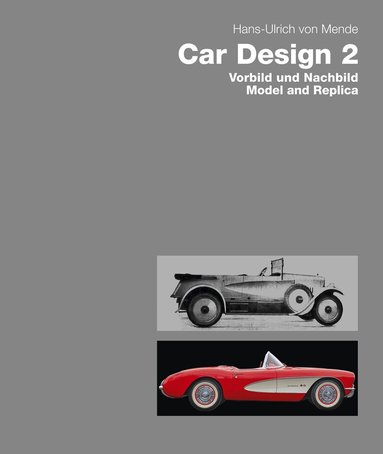
Car Design 2
- Vikt 1,2 kg
595 krhos Bokus · exkl. frakt
174 kr skillnad mellan billigaste och dyraste butik i lager
Dubbelkollat idag
Jämför 2 butiker
- Bokus, 595 kr, frakt enligt butiken. Till butik (öppnas i ny flik)
I lagerFrakt: se butikenDubbelkollad 14:51
595 kr
Lägst
- Akademibokhandeln, 769 kr, frakt enligt butiken. Till butik (öppnas i ny flik)
I lagerFrakt: se butikenDubbelkollad 14:53
769 kr

Priser från butikernas flöden kan ha ändrats: det är priset hos butiken som gäller, så kontrollera det innan du handlar.
Prishistorik
Köp nu eller vänta?
Just nu kostar produkten 595 kr — 11 kr över det lägsta vi sett på 3 veckor.
Under den tiden har det oftast legat runt 580 kr.
Pris idag
595 kr
- Lägst
- 584 kr
- Snitt
- 593 kr
- Högst
- 759 kr
| 2026-09-19 | 759 kr · Lägst hos Akademibokhandeln |
|---|---|
| 2026-09-20 | 584 kr · Lägst hos Bokus |
| 2026-10-11 | 595 kr · Lägst hos Bokus |
Om produkten
Car Design 2
Läs merLäs mindre
The automobile, the self-moved vehicle, existed long before Carl Benz's patented motor car of 1886. In 1769, Frenchman Nicolas-Joseph Cugnot crashed his steam-powered vehicle into a wall on its maiden voyage. In 1875, Austrian Siegfried Marcus presented a rudimentary motor-driven vehicle. However, even Benz's three-wheeled vehicle was still a long way from what we understand today as an automobile. Numerous developments followed in terms of wheels, mudguards, axles, springs, bonnets, seats, lamps, windscreens and roofs. By the turn of the century, the construction of the automobile as we know it today had been established: with four wheels of identical size and often already enclosed bodies, although formally and technically still indebted to carriage construction. The advent of closed bodies soon led to their previous materials of wood and fabric being replaced by sheet steel and glass, which allowed for arbitrary spatial deformations. In addition to necessary technical considerations, this inspired numerous formal variations. Initially, these variations mostly concerned the radiator, followed by the mudguards and windows, and later also the closed surfaces. With the design of the chassis to increase the wheelbase, passengers could now sit between the axles and not above them as before - with the result that the height of the car could be reduced. This also brought the car roof into focus and, in addition to new technical requirements, invited various formal variations. Lighting technology transformed carbide pots into real headlights. Glass surfaces cautiously ventured out of two-dimensionality into three-dimensional design. Ironically, it was technology-based aerodynamics that showed early signs of the modern car as we know it today.The book shows many examples of models and their replicas, although there can be large-time differences between the originaland the replica. Digitalised image research led to extensive and insightful results. However, it can also be assumed that an ideawas sometimes conceived completely independently and that the later designer had no knowledge of the earlier idea.
Specifikationer
Fakta
- Vikt
- 1,2 kg
- GTIN
- 09783869050492
Uppgifter från tillverkare och butiker.