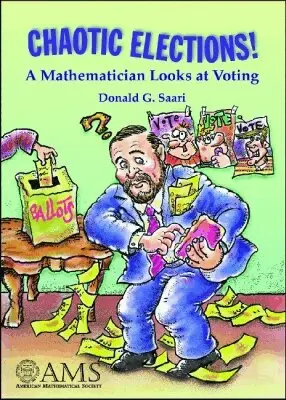
Chaotic Elections!
- Vikt 0,32 kg
485 krhos Bokus · exkl. frakt
144 kr skillnad mellan billigaste och dyraste butik i lager
Dubbelkollat idag
Jämför 2 butiker
- Bokus, 485 kr, frakt enligt butiken. Till butik (öppnas i ny flik)
I lagerFrakt: se butikenDubbelkollad 22:51
485 kr
Lägst
- Akademibokhandeln, 629 kr, frakt enligt butiken. Till butik (öppnas i ny flik)
I lagerFrakt: se butikenDubbelkollad 22:53
629 kr

Priser från butikernas flöden kan ha ändrats: det är priset hos butiken som gäller, så kontrollera det innan du handlar.
Prishistorik
Köp nu eller vänta?
Just nu kostar produkten 485 kr — 7 kr över det lägsta vi sett på 1 månad.
Under den tiden har det oftast legat runt 480 kr.
Pris idag
485 kr
- Lägst
- 478 kr
- Snitt
- 482 kr
- Högst
- 486 kr
| 2026-09-15 | 478 kr · Lägst hos Bokus |
|---|---|
| 2026-09-18 | 481 kr · Lägst hos Bokus |
| 2026-09-20 | 480 kr · Lägst hos Bokus |
| 2026-09-25 | 479 kr · Lägst hos Bokus |
| 2026-09-27 | 478 kr · Lägst hos Bokus |
| 2026-09-30 | 479 kr · Lägst hos Bokus |
| 2026-10-03 | 483 kr · Lägst hos Bokus |
| 2026-10-04 | 484 kr · Lägst hos Bokus |
| 2026-10-11 | 483 kr · Lägst hos Bokus |
| 2026-10-12 | 481 kr · Lägst hos Bokus |
| 2026-10-16 | 483 kr · Lägst hos Bokus |
| 2026-10-22 | 482 kr · Lägst hos Bokus |
| 2026-10-24 | 484 kr · Lägst hos Bokus |
| 2026-10-28 | 486 kr · Lägst hos Bokus |
| 2026-10-29 | 485 kr · Lägst hos Bokus |
Om produkten
What does the 2000 U.S
Läs merLäs mindre
presidential election have in common with selecting a textbook for a calculus course in your department? Was Ralph Nader's influence on the election of George W. Bush greater than the now-famous chads? In ""Chaotic Elections!"", Don Saari analyzes these questions, placing them in the larger context of voting systems in general. His analysis shows that the fundamental problems with the 2000 presidential election are not with the courts, recounts, or defective ballots, but are caused by the very way Americans vote for president. This expository book shows how mathematics can help to identify and characterize a disturbingly large number of paradoxical situations that result from the choice of a voting procedure. Moreover, rather than being able to dismiss them as anomalies, the likelihood of a dubious election result is surprisingly large.These consequences indicate that election outcomes - whether for president, the site of the next Olympics, the chair of a university department, or a prize winner - can differ from what the voters really wanted. They show that by using an inadequate voting procedure, we can, inadvertently, choose badly. To add to the difficulties, it turns out that the mathematical structures of voting admit several strategic opportunities, which are described. Finally, mathematics also helps identify positive results: by using mathematical symmetries, we can identify what the phrase 'what the voters really want' might mean and obtain a unique voting method that satisfies these conditions.Saari's book should be required reading for anyone who wants to understand not only what happened in the presidential election of 2000, but also how we can avoid similar problems from appearing anytime any group is making a choice using a voting procedure. Reading this book requires little more than high school mathematics and an interest in how the apparently simple situation of voting can lead to surprising paradoxes.
Specifikationer
Fakta
- Vikt
- 0,32 kg
- GTIN
- 09780821828472
Uppgifter från tillverkare och butiker.