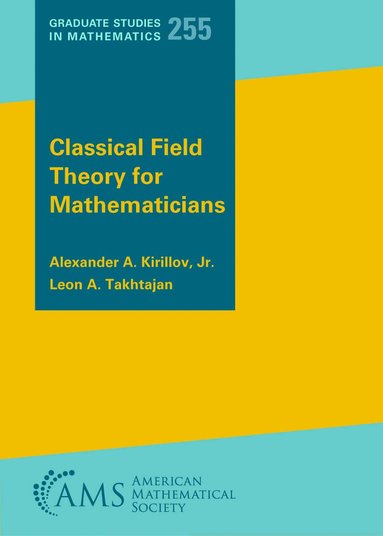
Classical Field Theory for Mathematicians
Dubbelkollat idag
Jämför 2 butiker
- Bokus, 1 074 kr, frakt enligt butiken. Till butik (öppnas i ny flik)
I lagerFrakt: se butikenDubbelkollad 20:51
1 074 kr
Lägst
- Akademibokhandeln, 1 399 kr, frakt enligt butiken. Till butik (öppnas i ny flik)
Slut i lagerFrakt: se butikenDubbelkollad 20:53
1 399 kr

Priser från butikernas flöden kan ha ändrats: det är priset hos butiken som gäller, så kontrollera det innan du handlar.
Prishistorik
Köp nu eller vänta?
Just nu kostar produkten 1 074 kr — 7 kr över det lägsta vi sett på 2 veckor.
Under den tiden har det oftast legat runt 1 070–1 080 kr.
Pris idag
1 074 kr
- Lägst
- 1 067 kr
- Snitt
- 1 094 kr
- Högst
- 1 399 kr
| 2026-10-02 | 1 399 kr · Lägst hos Akademibokhandeln |
|---|---|
| 2026-10-03 | 1 074 kr · Lägst hos Bokus |
| 2026-10-06 | 1 075 kr · Lägst hos Bokus |
| 2026-10-10 | 1 074 kr · Lägst hos Bokus |
| 2026-10-12 | 1 067 kr · Lägst hos Bokus |
| 2026-10-16 | 1 074 kr · Lägst hos Bokus |
Om produkten
Classical Field Theory for Mathematicians
Läs merLäs mindre
The aim of this book is to give a comprehensive treatment of the majority of important classical field theory from the mathematics perspective. The opening Part 1 gives the exposition of classical mechanics and special relativity that are based on the Hamiltonian approach and emphasizes the Hamiltonian action of the relevant Lie groups. Part 2 bridges classical mechanics and classical field theory. The authors develop all necessary tools: Lagrangian formulation of classical field theory, conservation laws, the Noether theorem, and Hamiltonian formulation. They present all necessary facts about jet bundles, multivariable calculus of variations, etc. Part 3 discusses gauge field theory: Maxwell's theory with the abelian structure group $U(1)$, and Yang-Mills theory with the structure group being semisimple compact Lie groups. For the convenience of the reader, the authors collect all necessary facts about connections and curvature in vector and principal bundles. In Part 4 the authors briefly discuss the theory of gravity, i.e., Einstein's general relativity. The goal here is to give a coherent mathematical exposition of the basic notions. After careful discussion of properties of the spacetime in general relativity and a standard derivation of Einstein's field equations with matter, the authors discuss the so-called Palatini formalism, an approach to Hilbert-Einstein action when 10 matrix elements of the metric tensor and 40 components of the symmetric Christoffel symbols are independent variables. They also briefly discuss Hamiltonian formalism for Einstein equations and their special solutions, with and without the cosmological constant. Each chapter in the book concludes with exercises aimed at developing deeper insights into topics discussed in the chapter. Also, each part concludes with a ""Notes and References"" chapter, which provides references to necessary mathematics background and physics sources.