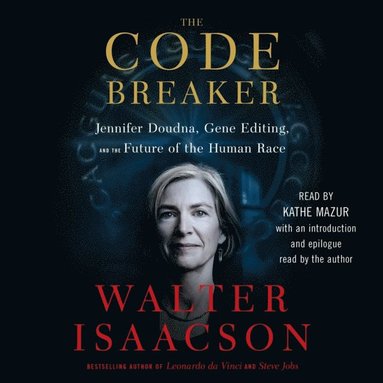
Code Breaker
Dubbelkollat idag
Jämför 1 butik
- Bokus, 454 kr, frakt enligt butiken. Till butik (öppnas i ny flik)
I lagerFrakt: se butikenDubbelkollad 13:51
454 kr
Lägst

Priser från butikernas flöden kan ha ändrats: det är priset hos butiken som gäller, så kontrollera det innan du handlar.
Prishistorik
Köp nu eller vänta?
Just nu kostar produkten 454 kr — 14 kr över det lägsta vi sett på 2 veckor.
Pris idag
454 kr
- Lägst
- 440 kr
- Snitt
- 450 kr
- Högst
- 454 kr
| 2026-10-02 | 440 kr · Lägst hos Bokus |
|---|---|
| 2026-10-06 | 454 kr · Lägst hos Bokus |
Om produkten
Code Breaker
Läs merLäs mindre
A 2022 Audie Award FinalistA Best Book of 2021 by Bloomberg BusinessWeek, Time, and The Washington Post The bestselling author of Leonardo da Vinci and Steve Jobs returns with a "compelling" (The Washington Post) account of how Nobel Prize winner Jennifer Doudna and her colleagues launched a revolution that will allow us to cure diseases, fend off viruses, and have healthier babies.When Jennifer Doudna was in sixth grade, she came home one day to find that her dad had left a paperback titled The Double Helix on her bed. She put it aside, thinking it was one of those detective tales she loved. When she read it on a rainy Saturday, she discovered she was right, in a way. As she sped through the pages, she became enthralled by the intense drama behind the competition to discover the code of life. Even though her high school counselor told her girls didn't become scientists, she decided she would. Driven by a passion to understand how nature works and to turn discoveries into inventions, she would help to make what the book's author, James Watson, told her was the most important biological advance since his codiscovery of the structure of DNA. She and her collaborators turned a curiosity of nature into an invention that will transform the human race: an easy-to-use tool that can edit DNA. Known as CRISPR, it opened a brave new world of medical miracles and moral questions. The development of CRISPR and the race to create vaccines for coronavirus will hasten our transition to the next great innovation revolution. The past half-century has been a digital age, based on the microchip, computer, and internet. Now we are entering a life-science revolution. Children who study digital coding will be joined by those who study genetic code. Should we use our new evolution-hacking powers to make us less susceptible to viruses? What a wonderful boon that would be! And what about preventing depression? Hmmm...Should we allow parents, if they can afford it, to enhance the height or muscles or IQ of their kids? After helping to discover CRISPR, Doudna became a leader in wrestling with these moral issues and, with her collaborator Emmanuelle Charpentier, won the Nobel Prize in 2020. Her story is an "enthralling detective story" (Oprah Daily) that involves the most profound wonders of nature, from the origins of life to the future of our species.