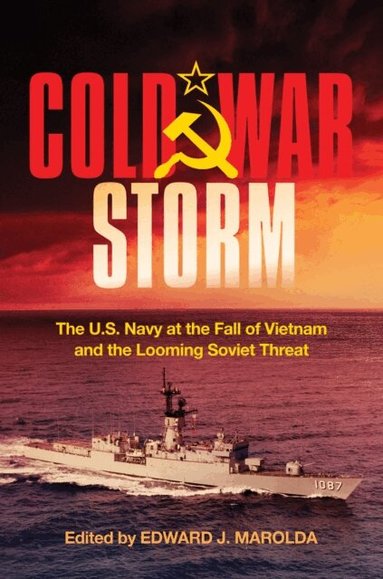
Cold War Storm
Dubbelkollat idag
Jämför 1 butik
- Bokus, 491 kr, frakt enligt butiken. Till butik (öppnas i ny flik)
I lagerFrakt: se butikenDubbelkollad 18:51
491 kr
Lägst

Priser från butikernas flöden kan ha ändrats: det är priset hos butiken som gäller, så kontrollera det innan du handlar.
Prishistorik
Köp nu eller vänta?
Just nu kostar produkten 491 kr — 11 kr över det lägsta vi sett på 2 veckor.
Pris idag
491 kr
- Lägst
- 480 kr
- Snitt
- 483 kr
- Högst
- 491 kr
| 2026-10-01 | 480 kr · Lägst hos Bokus |
|---|---|
| 2026-10-12 | 491 kr · Lägst hos Bokus |
Om produkten
This expertly curated volume explores how the U.S
Läs merLäs mindre
Navy transformed in the wake of Vietnam, from dramatic evacuation operations in Southeast Asia to Cold War recalibration against the Soviet threat. Cold War Storm offers a compelling look at how naval leaders redefined doctrine, strategy, and institutional culture to meet the demands of a rapidly changing global order.The end of the Vietnam War in April 1975 marked a turning point in the modern history of the U.S. Navy. During the final months of the conflict, naval forces carried out large-scale evacuations of Americans and Vietnamese under extraordinary conditions. The fall of Saigon not only closed the long war in Southeast Asia, but also forced the service to reassess its purpose, structure, and global responsibilities. In the aftermath, the Navy faced a different kind of challenge. The Soviet Union's expanding naval power demanded a new strategy, new ships, and a redefined mission. Cold War Storm details how Adm. Elmo R. Zumwalt Jr. and Adm. James L. Holloway III worked to reshape the fleet and the institution itself. The book traces how these efforts shaped doctrine, command, and culture in the years that followed. The first part of the book provides new insights into the U.S. evacuations from South Vietnam and Cambodia, the Mayaguez international crisis, and the Navy's role in those cataclysmic events. The latter chapters deal with broader postwar issues ranging from the debate within the intelligence community on the Soviet Navy's war plans, the evolution of U.S. strategy considering international developments, the U.S. Sixth Fleet's involvement in Vietnam-era crises in the Mediterranean, and the Navy's revolutionary personnel reforms.With chapters written by leading naval historians, this volume offers a detailed study of the U.S. Navy redefining itself not as a static force, but as an institution learning, adapting, and confronting the realities of global power in the late twentieth century.