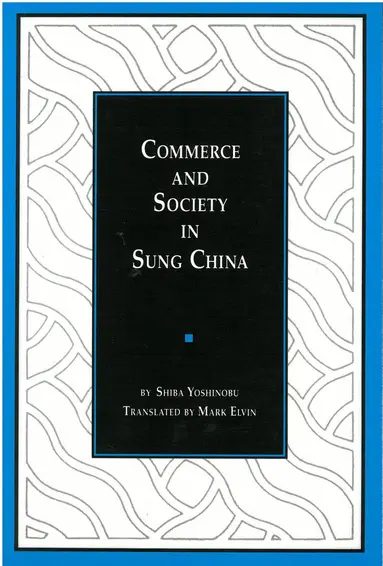
Commerce and Society in Sung China
269 kr270 kr−0% senaste veckanhos Bokus · exkl. frakt
Jämfört med det lägsta pris vi sett de 30 dagarna före sänkningen.
80 kr skillnad mellan billigaste och dyraste butik i lager
Dubbelkollat idag
Jämför 2 butiker
- Bokus, 269 kr, frakt enligt butiken. Till butik (öppnas i ny flik)
I lagerFrakt: se butikenDubbelkollad 07:51
269 kr
Lägst
- Akademibokhandeln, 349 kr, frakt enligt butiken. Till butik (öppnas i ny flik)
I lagerFrakt: se butikenDubbelkollad 07:53
349 kr

Priser från butikernas flöden kan ha ändrats: det är priset hos butiken som gäller, så kontrollera det innan du handlar.
Prishistorik
Köp nu eller vänta?
Just nu kostar produkten 269 kr — 1 kr över det lägsta vi sett på 1 månad.
Under den tiden har det oftast legat runt 270 kr.
Pris idag
269 kr
- Lägst
- 268 kr
- Snitt
- 270 kr
- Högst
- 272 kr
| 2026-09-15 | 268 kr · Lägst hos Bokus |
|---|---|
| 2026-09-18 | 269 kr · Lägst hos Bokus |
| 2026-09-20 | 268 kr · Lägst hos Bokus |
| 2026-09-23 | 269 kr · Lägst hos Bokus |
| 2026-09-25 | 268 kr · Lägst hos Bokus |
| 2026-10-02 | 270 kr · Lägst hos Bokus |
| 2026-10-04 | 271 kr · Lägst hos Bokus |
| 2026-10-08 | 272 kr · Lägst hos Bokus |
| 2026-10-10 | 271 kr · Lägst hos Bokus |
| 2026-10-11 | 270 kr · Lägst hos Bokus |
| 2026-10-16 | 271 kr · Lägst hos Bokus |
| 2026-10-17 | 270 kr · Lägst hos Bokus |
| 2026-10-24 | 271 kr · Lägst hos Bokus |
| 2026-10-28 | 272 kr · Lägst hos Bokus |
| 2026-11-01 | 269 kr · Lägst hos Bokus |
Om produkten
Commerce and Society in Sung China
Läs merLäs mindre
The full dimensions of the medieval Chinese economic revolution are still almost unknown to economic historians in the Western world, and the manifold problems that it raises for accepted theories of economic development have hardly begun to be systematically considered. Japanese scholars have been the pioneers in opening up this field, and Professor Shiba's Commerce and Society in Sung China is among the most recent and most impressive fruits of their labors. For the first time it is possible to be relatively confident, as the result of the author's systematic exploitation of an enormous range of source materials, about the parts played by transport, trade, business organization and urbanization in this revolution. It is hardly necessary to labor the significance of the advance. China's was beyond any reasonable doubt the most developed economy in the medieval world, and the investigation both of the causes that made this possible and of those that subsequently prevented a take-off into sustained growth is among the most pressing tasks waiting to be accomplished before any general theory of economic development, solidly grounded in comparative historical analysis, becomes possible.