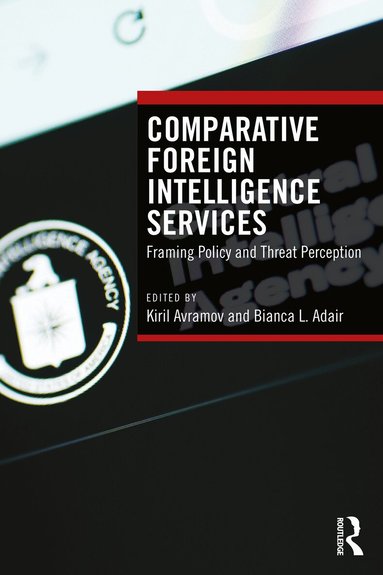
Comparative Foreign Intelligence Services
- Vikt 0,41 kg
648 krhos Bokus · exkl. frakt
191 kr skillnad mellan billigaste och dyraste butik i lager
Dubbelkollat idag
Jämför 2 butiker
- Bokus, 648 kr, frakt enligt butiken. Till butik (öppnas i ny flik)
I lagerFrakt: se butikenDubbelkollad 14:51
648 kr
Lägst
- Akademibokhandeln, 839 kr, frakt enligt butiken. Till butik (öppnas i ny flik)
I lagerFrakt: se butikenDubbelkollad 14:53
839 kr

Priser från butikernas flöden kan ha ändrats: det är priset hos butiken som gäller, så kontrollera det innan du handlar.
Prishistorik
Köp nu eller vänta?
Just nu kostar produkten 648 kr — 7 kr över det lägsta vi sett på 2 veckor.
Under den tiden har det oftast legat runt 640–650 kr.
Pris idag
648 kr
- Lägst
- 641 kr
- Snitt
- 656 kr
- Högst
- 829 kr
| 2026-09-30 | 829 kr · Lägst hos Akademibokhandeln |
|---|---|
| 2026-10-01 | 641 kr · Lägst hos Bokus |
| 2026-10-04 | 644 kr · Lägst hos Bokus |
| 2026-10-08 | 651 kr · Lägst hos Bokus |
| 2026-10-10 | 650 kr · Lägst hos Bokus |
| 2026-10-11 | 648 kr · Lägst hos Bokus |
| 2026-10-12 | 646 kr · Lägst hos Bokus |
| 2026-10-16 | 648 kr · Lägst hos Bokus |
Om produkten
Comparative Foreign Intelligence Services
Läs merLäs mindre
This edited volume develops a comparative theory of post-Cold War intelligence liaison between the U.S. intelligence community and its international counterparts.It presents the U.S. perspective on these liaisons and moves beyond simple ally-adversary classifications, showing how cooperation is influenced by strategic threat perception, material power, access to intelligence, and institutional culture. The core of the book rests on a dual framework that combines neoclassical realism and intelligence studies: states pursue liaison not only due to formal alliances or power but also because threat perceptions, institutional culture, and intelligence access interact to create or limit decision advantages. Additionally, the volume advances our understanding of strategic institutional intelligence culture - the patterns through which intelligence agencies influence threat perception, policy interaction, secrecy management, and oversight. It classifies U.S. intelligence relationships along a spectrum: enduring partnerships, wary alliances, and transactional exchanges. The empirical section applies this framework to case studies including British-American and Israeli-American cooperation; Chinese and Russian intelligence under near-peer competition; and Cuban and Iranian systems influenced by regime security, revolutionary ideology, and gray-zone tactics. Examining the nature, type, and quality of interactions with intelligence agencies worldwide, along with an understanding of these interactions, is key to effective and smart intelligence practices.This book will be of much interest to students of intelligence studies, national security, foreign policy, and international relations, as well as practitioners.
Specifikationer
Fakta
- Vikt
- 0,41 kg
- GTIN
- 09781032566238
Uppgifter från tillverkare och butiker.