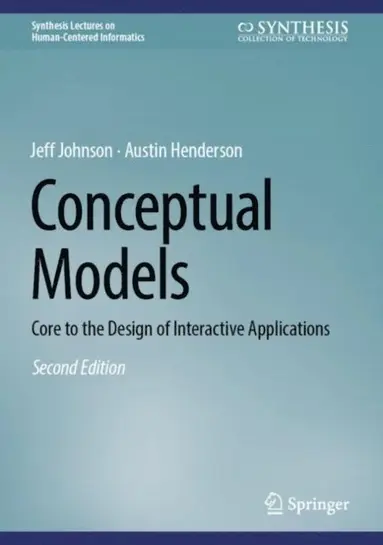
Conceptual Models
Dubbelkollat idag
Jämför 1 butik
- Bokus, 652 kr, frakt enligt butiken. Till butik (öppnas i ny flik)
I lagerFrakt: se butikenDubbelkollad 00:51
652 kr
Lägst

Priser från butikernas flöden kan ha ändrats: det är priset hos butiken som gäller, så kontrollera det innan du handlar.
Prishistorik
Köp nu eller vänta?
Just nu kostar produkten 652 kr — 14 kr över det lägsta vi sett på 1 månad.
Pris idag
652 kr
- Lägst
- 638 kr
- Snitt
- 645 kr
- Högst
- 652 kr
| 2026-09-15 | 638 kr · Lägst hos Bokus |
|---|---|
| 2026-10-10 | 652 kr · Lägst hos Bokus |
Om produkten
Conceptual Models
Läs merLäs mindre
This book presents readers with an exploration of the concept of Conceptual Models and argues that they are core to achieving good design of interactive applications that are easy, effective, and enjoyable to use. The authors' years of experience helping companies create interactive software applications revealed that interactive applications built without Conceptual Models generally result in fraught production processes and designs that are confusing and difficult to learn, remember, and use. Instead, the book shows that Conceptual Models can be a central link between the elements involved in the use of interactive applications: people's tasks (domains), their plans for performing those tasks, the use of applications in the plans, the conceptual structure of applications, the presentation of the conceptual model (i.e., the user interface), the terms used to describe it, its implementation, and the learning that people must do to use the application. Readers will learn how putting a Conceptual Model at the core of the design and development process can pay rich dividends: designs are simpler, more coherent, and better aligned with users' tasks; unnecessary features are avoided; documentation is easier, development is faster and cheaper; customer uptake is improved; and the need for training and customer support is reduced. To support its use in instruction, this second edition has been revised to explain the history and theoretical context of conceptual modeling using a consistent vocabulary, describe the structure of conceptual models, provide more current and more complete examples, explain how conceptual models fit into design and development, and further summarize the benefits of conceptual modeling.