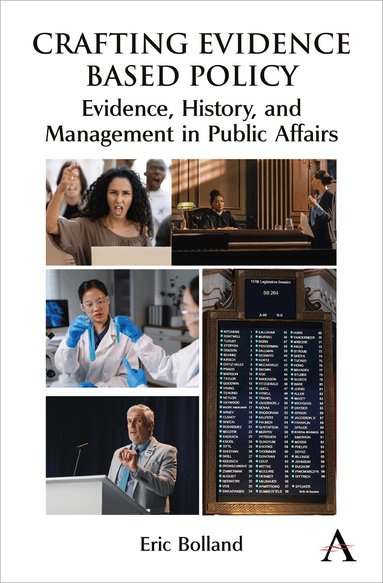
Crafting Evidence Based Policy
- Vikt 0,45 kg
Bra pris nuLägsta priset på 4 veckor
1 281 kr1 669 kr−23% senaste veckanhos Bokus · exkl. frakt
Jämfört med det lägsta pris vi sett de 30 dagarna före sänkningen.
388 kr skillnad mellan billigaste och dyraste butik i lager
Dubbelkollat idag
Jämför 2 butiker
- Bokus, 1 281 kr, frakt enligt butiken. Till butik (öppnas i ny flik)
I lagerFrakt: se butikenDubbelkollad 19:51
1 281 kr
Lägst
- Akademibokhandeln, 1 669 kr, frakt enligt butiken. Till butik (öppnas i ny flik)
I lagerFrakt: se butikenDubbelkollad 19:53
1 669 kr

Priser från butikernas flöden kan ha ändrats: det är priset hos butiken som gäller, så kontrollera det innan du handlar.
Prishistorik
Köp nu eller vänta?
Just nu kostar produkten 1 281 kr — det lägsta vi sett på 4 veckor.
Under den tiden har det oftast legat runt 1 670–1 710 kr.
Pris idag
1 281 kr
- Lägst
- 1 281 kr
- Snitt
- 1 625 kr
- Högst
- 2 219 kr
| 2026-09-17 | 2 219 kr · Lägst hos Akademibokhandeln |
|---|---|
| 2026-09-18 | 1 709 kr · Lägst hos Bokus |
| 2026-10-09 | 1 669 kr · Lägst hos Akademibokhandeln |
| 2026-10-10 | 1 281 kr · Lägst hos Bokus |
Om produkten
Crafting Evidence Based Policy
Läs merLäs mindre
Provides a comprehensive multinational analysis of evidence based policy making, examining how evidence is defined, interpreted, and used across professions, governance systems, and leadership contexts to shape public policy and legislation.The book begins with an introduction of the author and his qualifications for writing it. The ubiquity of policy along with the policy process is described and policy is defined. Why policies fail is addressed. Policy making in education and medicine is presented and various influencers are identified, and a diagram of the hierarchy of policies is shown.Next, the historical origins of policies are traced back to ancient family groups in China and the emergence of cities and democracies in Greece. The impact of the Industrial Revolution and Age of Revolution are discussed. Policy development both within and outside government is examined.What follows is an analysis of the role of evidence in policy formation with a depiction of effective use of evidence. Distortions of evidence are detailed and policy-making tools such as cost-benefit analysis and statistical tools are discussed. A section on the problems of such analysis is provided along with recommendations on which tools to use.Scientific evidence in policy is then presented with a discussion of how scientists like Darwin use the scientific method to make conclusions. The reactions of office holders is discussed. The rise in the influence of science on public policy is then explained, especially during world wars with the development of atomic weapons. Ethical issues are presented and the matter of becoming an influential scientific advisor is discussed.Journalistic and communication based evidence follows with a history of print and broadcast media. Journalism during war is described and the interaction between the media and legislators is offered. Finally, an interview with journalism professor Sam Freedman provides in-depth insight on chief ethical issues.For the topic of the influence of law and the judiciary, the book details how close the connection is with policy making. A review of the English foundations of law and the rapid growth of courts demonstrates its importance on policy making. Many office holders are lawyers and standards for evidence are high and thus applicable in legislation.Other policy influencers are introduced next. These are deep rooted and are religion, business, unions, and education. The histories of each in policy making are described along with an evaluation of their relative power in evidence based policy.The overlay of policy creation in the context of strategy, strategizing, and structure is the next topic. The evolution of long-term planning to strategic planning to strategic management is plotted along with an analysis of how policy can be implemented. Strategizing is described as the active attention to strategic opportunities by involving all members of an organization. A series of strategic analysis tools are introduced to the reader. For structure, a comparison by presidential and parliamentary systems is offered regarding policy formation.The last part of the book deals with communications in general, management, leadership, and recent developments in global policy issues. The value of the policy memo and importance of Op Ed's media conferences, town halls, and petitions are described. The history of management is detailed along with how that influences public administration especially in bureaucracy. The advantages of servant leadership is described. Finally, seven major international policy issues that need to be addressed are presented.
Specifikationer
Fakta
- Vikt
- 0,45 kg
- GTIN
- 09781801361354
Uppgifter från tillverkare och butiker.