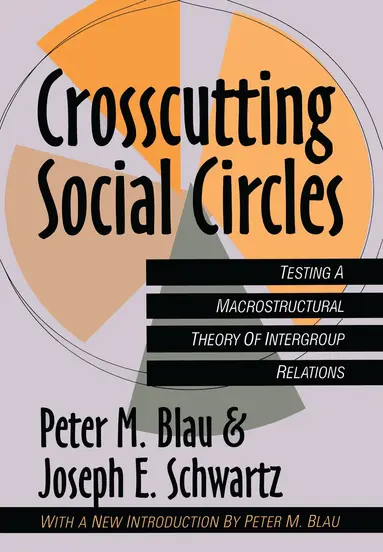
Crosscutting Social Circles
- Vikt 0,56 kg
747 krhos Bokus · exkl. frakt
222 kr skillnad mellan billigaste och dyraste butik i lager
Dubbelkollade priser
Jämför 3 butiker
- Bokus, 747 kr, frakt enligt butiken. Till butik (öppnas i ny flik)
I lagerFrakt: se butikenDubbelkollad 21:51
747 kr
Lägst
- Akademibokhandeln, 969 kr, frakt enligt butiken. Till butik (öppnas i ny flik)
I lagerFrakt: se butikenDubbelkollad 21:53
969 kr
- Adlibris, 632 kr, frakt enligt butiken. Till butik (öppnas i ny flik)
Slut i lagerFrakt: se butikenDubbelkollad 27 okt. 09:10
632 kr


Priser från butikernas flöden kan ha ändrats: det är priset hos butiken som gäller, så kontrollera det innan du handlar.
Prishistorik
Köp nu eller vänta?
Just nu kostar produkten 747 kr — 115 kr över det lägsta vi sett på 1 månad.
Under den tiden har det oftast legat runt 630–740 kr.
Pris idag
747 kr
- Lägst
- 632 kr
- Snitt
- 687 kr
- Högst
- 747 kr
| 2026-09-15 | 632 kr · Lägst hos Adlibris |
|---|---|
| 2026-10-08 | 746 kr · Lägst hos Bokus |
| 2026-10-10 | 745 kr · Lägst hos Bokus |
| 2026-10-12 | 740 kr · Lägst hos Bokus |
| 2026-10-16 | 745 kr · Lägst hos Bokus |
| 2026-10-17 | 743 kr · Lägst hos Bokus |
| 2026-10-24 | 744 kr · Lägst hos Bokus |
| 2026-10-27 | 745 kr · Lägst hos Bokus |
| 2026-10-28 | 747 kr · Lägst hos Bokus |
Om produkten
Crosscutting Social Circles
Läs merLäs mindre
Crosscutting Social Circles describes a theory of groups' relations to each other, and tests the theory in the 125 largest metropolitan areas In the United States. The focus is on the Influence social structure exerts on intergroup relations. Blau and Schwartz show how role relations are influenced by how people are distributed among social positions. Examples are a community's racial composition, division of labor, ethnic heterogeneity, income Inequality, or the extent to which educational differences are related to income differences. Blau and Schwartz test their theory by considering its impact on such structural conditions as intermarriage, an important form of intergroup relations.The authors derive the main principles of previously formulated theories of intergroup relations and present them in simpler and clearer form. They empirically test the power of the theory by analyzing its ability to predict how social structure affects intermarriage in the largest American cities, where three-fifths of the American population live. They selected cities because population distribution of a small neighborhood might be affected by casual associations among neighbors; it is much more sociologically interesting if population distribution also affects mate selection in a city of millions.Unlike most theories that emphasize the implications of such cultural orientations as shared values and common norms, this volume focuses on the significance of various forms of inequality and heterogeneity. As one of the few books that supplies a large-scale empirical test of implications of a theory, Crosscutting Social Circles serves as a model. The new introduction by Peter Blau reviews the origins and impact of the book. It will be of immense value to sociologists, psychologists, and group relations specialists.
Specifikationer
Fakta
- Vikt
- 0,56 kg
- GTIN
- 09781560009030
Uppgifter från tillverkare och butiker.