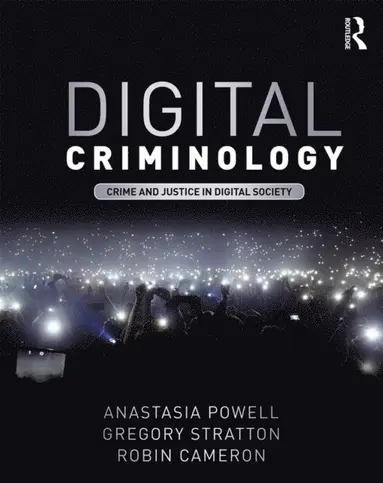
Digital Criminology
Dubbelkollat idag
Jämför 1 butik
- Bokus, 829 kr, frakt enligt butiken. Till butik (öppnas i ny flik)
I lagerFrakt: se butikenDubbelkollad 02:51
829 kr
Lägst

Priser från butikernas flöden kan ha ändrats: det är priset hos butiken som gäller, så kontrollera det innan du handlar.
Prishistorik
Köp nu eller vänta?
Just nu kostar produkten 829 kr — 27 kr över det lägsta vi sett på 1 månad.
Pris idag
829 kr
- Lägst
- 802 kr
- Snitt
- 816 kr
- Högst
- 829 kr
| 2026-09-15 | 802 kr · Lägst hos Bokus |
|---|---|
| 2026-10-08 | 829 kr · Lägst hos Bokus |
Om produkten
Digital Criminology
Läs merLäs mindre
The infusion of digital technology into contemporary society has had significant effects for everyday life and for everyday crimes. Digital Criminology: Crime and Justice in Digital Society is the first interdisciplinary scholarly investigation extending beyond traditional topics of cybercrime, policing and the law to consider the implications of digital society for public engagement with crime and justice movements. This book seeks to connect the disparate fields of criminology, sociology, legal studies, politics, media and cultural studies in the study of crime and justice. Drawing together intersecting conceptual frameworks, Digital Criminology examines conceptual, legal, political and cultural framings of crime, formal justice responses and informal citizen-led justice movements in our increasingly connected global and digital society. Building on case study examples from across Australia, Canada, Europe, China, the UK and the United States, Digital Criminology explores key questions including: What are the implications of an increasingly digital society for crime and justice? What effects will emergent technologies have for how we respond to crime and participate in crime debates? What will be the foundational shifts in criminological research and frameworks for understanding crime and justice in this technologically mediated context? What does it mean to be a 'just' digital citizen? How will digital communications and social networks enable new forms of justice and justice movements? Ultimately, the book advances the case for an emerging digital criminology: extending the practical and conceptual analyses of 'cyber' or 'e' crime beyond a focus foremost on the novelty, pathology and illegality of technology-enabled crimes, to understandings of online crime as inherently social.Twitter: @DigiCrimRMIT