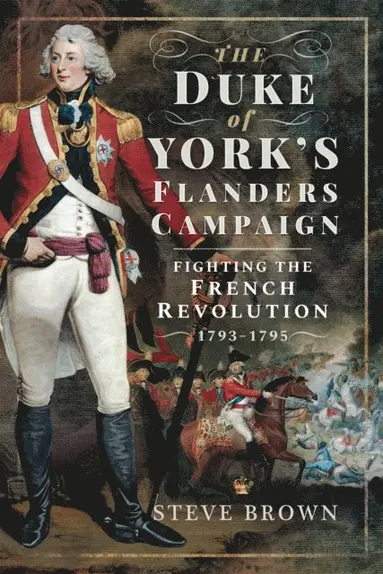
Duke of York's Flanders Campaign
Bra pris nuLägsta priset på 1 månad
22 krhos Bokus · exkl. frakt
Dubbelkollat idag
Jämför 1 butik
- Bokus, 22 kr, frakt enligt butiken. Till butik (öppnas i ny flik)
I lagerFrakt: se butikenDubbelkollad 05:51
22 kr
Lägst

Priser från butikernas flöden kan ha ändrats: det är priset hos butiken som gäller, så kontrollera det innan du handlar.
Prishistorik
Köp nu eller vänta?
Just nu kostar produkten 22 kr — det lägsta vi sett på 1 månad.
Under den tiden har det oftast legat runt 20–100 kr.
Pris idag
22 kr
- Lägst
- 22 kr
- Snitt
- 51 kr
- Högst
- 103 kr
| 2026-09-15 | 29 kr · Lägst hos Bokus |
|---|---|
| 2026-09-17 | 101 kr · Lägst hos Bokus |
| 2026-09-24 | 29 kr · Lägst hos Bokus |
| 2026-10-12 | 103 kr · Lägst hos Bokus |
| 2026-10-20 | 22 kr · Lägst hos Bokus |
Om produkten
"A superb read
Läs merLäs mindre
. . destined to become the go-to book for anyone interested in this long-neglected period of the Revolutionary and Napoleonic Wars." -The Napoleon Series To crush the French Revolution, the armies of the First Coalition gathered round France''s borders, the largest of which was assembled in Flanders. Composed of Anglo-Hanoverian, Dutch, Hessian, Prussian and Imperial Austrian troops, its aim was to invade France and restore the nobility to what was considered their rightful place. Opposing them was the French Armée du Nord. In command of the Anglo-Hanoverian contingent was the son of George III, the Duke of York. The campaign was a disaster for the Coalition forces, particularly during the severe winter of 1794/5 when the troops were forced into a terrible and humiliating retreat. Britain''s reputation and that of its military leaders was severely diminished, with the forces of the Revolution sweeping all before them on a tide of popularism. Yet, from this defeat grew an army that under the Duke of Wellington would eventually crush the Revolution''s greatest general, Napoleon Bonaparte. Of the Flanders Campaign, Wellington, who fought as a junior officer under the Duke of York, remarked that the experience had at least taught him what not to do. Napoleon Series research editor Steve Brown has produced one of the most insightful, and much-needed studies of this disastrous but intriguing campaign, with particular focus on the British Army''s contribution. With copious maps and nineteen appendices including detailed orders of battle, he concludes this important work with an analysis that draws striking, and significant comparisons with the Flanders campaigns of 1914 and 1940. How history repeats itself . . .