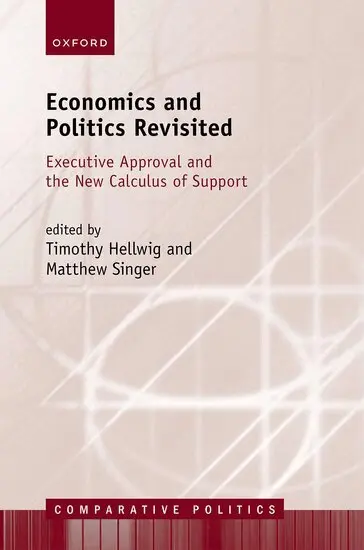
Economics and Politics Revisited
- Vikt 0,78 kg
1 542 krhos Bokus · exkl. frakt
467 kr skillnad mellan billigaste och dyraste butik i lager
Dubbelkollat idag
Jämför 2 butiker
- Bokus, 1 542 kr, frakt enligt butiken. Till butik (öppnas i ny flik)
I lagerFrakt: se butikenDubbelkollad 16:51
1 542 kr
Lägst
- Akademibokhandeln, 2 009 kr, frakt enligt butiken. Till butik (öppnas i ny flik)
I lagerFrakt: se butikenDubbelkollad 16:53
2 009 kr

Priser från butikernas flöden kan ha ändrats: det är priset hos butiken som gäller, så kontrollera det innan du handlar.
Om produkten
What drives government popularity?
Läs merLäs mindre
For decades, scholars, journalists, and political pundits alike have converged on a single answer: the economy. A rising economy lifts the popularity of the government, and if the economy's fortunes turn south, so too does that of the government. This conventional wisdom informs politicians' decisions as well as the scholarly commentary on parties and elections. Yet the conditions that underlie this model have changed in many countries as globalization has shifted control away from national policymakers, as non-economic cultural issues have risen in importance, and as our politics have become more polarized. At the same time, since the Great Recession in 2008 persistent economic volatility has kept the economy on the agenda. What, then, fuels government popularity in our current volatile environment? Are political fortunes tied to economic stability, as in the past? Or has the economy-popularity link-the popularity function-been severed by a host of new and less predictable factors in post-industrial societies?To answer these questions, Economics and Politics Revisited uses data from the Executive Approval Project (EAP), a cross-nationally comparable data on leader popularity, to model the fundamental dynamics of government support in advanced industrial democracies. Eleven country-specific chapters, each written by experts in the politics of the country, examine the role of economic performance in generating leader support in each country. In all cases, chapter authors show that the economy matters for popularity. However, the economy-popularity link is stronger in some countries than others. Further, chapters leverage EAP series to highlight change over time. Pooled analyses extend these findings, highlighting how the public's responses to the economy are reduced when political campaigns shift to non-economic issues and when parties are polarization on non-economic issues. Collectively, the volume highlights how evolving issue agendas are changing the nature of political accountability in advanced industrialized democracies. While the economy remains important, the book calls on students of political accountability to give greater attention to the role of non-economic issues.Comparative Politics is a series for researchers, teachers, and students of political science that deals with contemporary government and politics. Global in scope, books in the series are characterized by a stress on comparative analysis and strong methodological rigour. The series is published in association with the European Consortium for Political Research. For more information visit: www.ecprnet.eu .The series is edited by Nicole Bolleyer, Chair of Comparative Political Science, Geschwister Scholl Institut, LMU Munich and Jonathan Slapin, Professor of Political Institutions and European Politics, Department of Political Science, University of Zurich.
Specifikationer
Fakta
- Vikt
- 0,78 kg
- GTIN
- 09780192871664
Uppgifter från tillverkare och butiker.