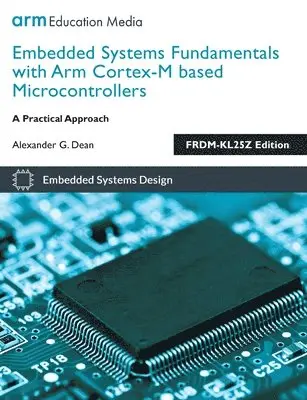
Embedded Systems Fundamentals with Arm Cortex M Based Microcontrollers
- Vikt 0,58 kg
536 krhos Bokus · exkl. frakt
163 kr skillnad mellan billigaste och dyraste butik i lager
Dubbelkollade priser
Jämför 3 butiker
- Bokus, 536 kr, frakt enligt butiken. Till butik (öppnas i ny flik)
I lagerFrakt: se butikenDubbelkollad 07:51
536 kr
Lägst
- Akademibokhandeln, 699 kr, frakt enligt butiken. Till butik (öppnas i ny flik)
I lagerFrakt: se butikenDubbelkollad 07:53
699 kr
- Adlibris, 422 kr, frakt enligt butiken. Till butik (öppnas i ny flik)
Slut i lagerFrakt: se butikenDubbelkollad 27 okt. 09:10
422 kr


Priser från butikernas flöden kan ha ändrats: det är priset hos butiken som gäller, så kontrollera det innan du handlar.
Prishistorik
Köp nu eller vänta?
Just nu kostar produkten 536 kr — 114 kr över det lägsta vi sett på 1 månad.
Under den tiden har det oftast legat runt 420–540 kr.
Pris idag
536 kr
- Lägst
- 422 kr
- Snitt
- 480 kr
- Högst
- 536 kr
| 2026-09-15 | 422 kr · Lägst hos Adlibris |
|---|---|
| 2026-10-08 | 525 kr · Lägst hos Bokus |
| 2026-10-13 | 536 kr · Lägst hos Bokus |
Om produkten
Embedded Systems Fundamentals with Arm Cortex M Based Microcontrollers
Läs merLäs mindre
Microcontrollers are embedded into larger systems to provide benefits such as better performance, more features, better efficiency, lower costs and better dependability. This textbook introduces students to creating microcontroller-based embedded systems featuring an ARM Cortex-M CPU core.Chapter 1 introduces students to the concepts of MCU-based embedded systems, and how they differ from general-purpose computers. It then introduces the ARM Cortex-M0+ CPU, the Kinetis KL25Z MCU, and the low cost FRDM-KL25Z MCU development board.Chapter 2 presents the general purpose I/O peripheral to provide an early, hands-on experience with reading switches and lighting LEDs using C code. It also introduces the CMSIS hardware abstraction layer, which simplifies software access to peripherals.Chapter 3 introduces multitasking on the CPU, with the goals of improving responsiveness and software modularity while reducing CPU overhead. The interplay of interrupts, peripherals and schedulers (both cooperative and preemptive) is examined.Chapter 4 presents the ARM Cortex-M0+ processor core, including organization, registers, memory, and instruction set. It then discusses interrupts and exceptions, including CPU response and hardware configuration. Designing software for a system with interrupts is discussed, including program design (including partitioning work), interrupt configuration, writing handlers in C, and sharing data safely given preemption.Chapter 5 first gives an overview of tool-chain which translates a program from C source code to executable object code. It then shows side-by-side the source code and the object code the tool-chain has generated to implement it. Topics covered include functions, arguments, return values, activation records, exception handlers, control flow constructs for loops and selection, memory allocation and use, and accessing data in memory.Chapter 6 presents analog interfacing, starting with theory and ending with practical implementations. Quantization and sampling are presented as a foundation for digital to analog conversion, and analog to digital conversion. The DAC, ADC and analog comparator peripherals are presented and used.Chapter 7 presents timer peripherals and their use for generating a periodic interrupt or a pulse-width modulated signal, or for measuring elapsed time or a signal's frequency. Watchdog timers, used to detect and reset an out-of-control program, are also discussed. The SysTick, PIT, TPM and COP timers are examined.Chapter 8 discusses serial communications, starting with the fundamentals of data serialization, framing, error detection, media access control and addressing. Software queues are introduced to show how to buffer data between communication ISRs and other parts of the program. Three protocols and their supporting peripherals are investigated next: SPI, asynchronous serial (UART) and I2C. UART communication is demonstrated using the FRDM-KL25Z's debug MCU as a serial port bridge over USB to the PC. I2C communication is demonstrated using the FRDM-KL25Z's built-in 3 axis accelerometer with I2C interface.Chapter 9 introduces the direct memory access peripheral and its ability to transfer data autonomously, offloading work from the CPU and offering dramatically improved performance. Examples include using DMA for bulk data copying, and for DAC-based analog waveform generation with precise timing.An appendix covers how to measure the power and energy use on the FRDM-KL25Z board, including disconnecting the debug MCU to reduce power. Energy measurement using an ultracapacitor is also presented.For use in ECE, EE, and CS departments.
Specifikationer
Fakta
- Vikt
- 0,58 kg
- GTIN
- 09781911531036
Uppgifter från tillverkare och butiker.