Everything Is Everything
Dubbelkollat idag
Jämför 1 butik
- Bokus, 268 kr, frakt enligt butiken. Till butik (öppnas i ny flik)
I lagerFrakt: se butikenDubbelkollad 14:51
268 kr
Lägst

Priser från butikernas flöden kan ha ändrats: det är priset hos butiken som gäller, så kontrollera det innan du handlar.
Prishistorik
Köp nu eller vänta?
Just nu kostar produkten 268 kr — 6 kr över det lägsta vi sett på 2 veckor.
Pris idag
268 kr
- Lägst
- 262 kr
- Snitt
- 264 kr
- Högst
- 268 kr
| 2026-10-01 | 262 kr · Lägst hos Bokus |
|---|---|
| 2026-10-13 | 268 kr · Lägst hos Bokus |
Om produkten
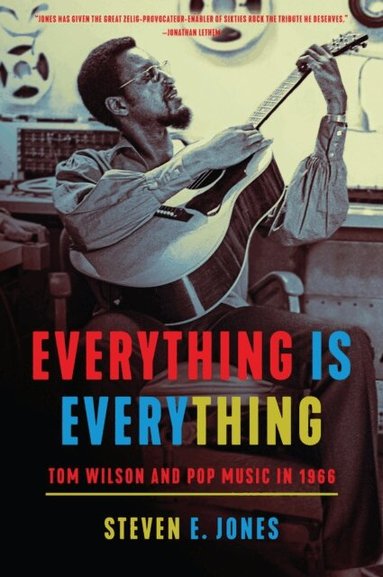
Everything Is Everything
Läs merLäs mindre
In the tradition of The Old, Weird America and Deliver Me from Nowhere, cultural critic Steven E. Jones explores American pop culture through the work of record producer Tom Wilson, and the artists with whom he collaborated in the miraculous year 1966.1966 was a transformative year in popular culture, and especially in popular music. It's the year when go-go dancing met the electric blues, bubblegum pop met underground rock, free jazz met psychedelia, and they all morphed into one another like fluid blobs in a liquid light show. Diversifying radio formats, including the emergence of underground FM stations, greeted an efflorescence of boundary-breaking artists, records, and songs, at once showcasing and encouraging fervent experimentation. At the center of these changes, by turns channeling and amplifying these vibrant energies, stood the profoundly influential, if subsequently unheralded, record producer, Tom Wilson.It would be hard to find a figure more solidly located at the junction of the currents traversing America in 1966: a Black man working in almost exclusively white studio settings, Wilson played a vital role in an astonishing array of landmark records: after producing Bob Dylan and Simon & Garfunkel in the previous year, in 1966 alone Wilson produced albums from Frank Zappa & the Mothers of Invention, The Velvet Underground, Hugh Masekela, The Animals, and more. Any one of these would be a standout on most producers' resumes. Taken together, they testify to an influential career, and invite a new appraisal of a pivotal moment in American pop culture. As Jones reveals in this energetic account, Wilson's radical eclecticism, his embrace of diverse musical genres, was a response to the times, as was his engagement with the music industry as a whole and with the low and the high in pop culture. It was all part of making pop music in what he called an era of complex mixed media, and what he meant by his often-repeated catch-phrase, everything is everything.Dying young in 1978, without leaving behind a significant archive of interviews or writings, Wilson has been unjustly overlooked. Everything is Everything provides a long overdue testimonial, celebrating him as an avatar of the most important trend in pop music in 1966: an exploding eclecticism, accompanied by a sometimes desperate search for authenticity.