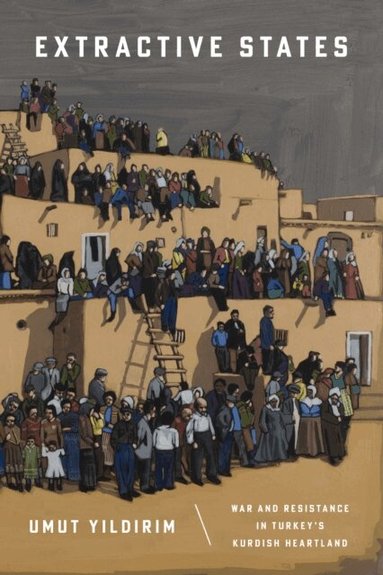
Extractive States
Dubbelkollat idag
Jämför 1 butik
- Bokus, 464 kr, frakt enligt butiken. Till butik (öppnas i ny flik)
I lagerFrakt: se butikenDubbelkollad 20:51
464 kr
Lägst

Priser från butikernas flöden kan ha ändrats: det är priset hos butiken som gäller, så kontrollera det innan du handlar.
Prishistorik
Köp nu eller vänta?
Just nu kostar produkten 464 kr — 10 kr över det lägsta vi sett på 2 veckor.
Pris idag
464 kr
- Lägst
- 454 kr
- Snitt
- 458 kr
- Högst
- 464 kr
| 2026-10-01 | 454 kr · Lägst hos Bokus |
|---|---|
| 2026-10-10 | 464 kr · Lägst hos Bokus |
Om produkten
Extractive States
Läs merLäs mindre
The Turkish state and the Kurdistan Workers' Party engaged in a counterinsurgency war for nearly four decades. Over this period, Diyarbakir, the de facto capital of Greater Kurdistan, was a site of sieges and ceasefires, welfare and humanitarian relief, NGO interventions and decolonial resistance-the complementary, intertwined processes of low-intensity war. War turned urban slums into high-security frontiers and transactional hubs for policy design, and settled deep into embodied knowledges and environments. Through committed and engaged ethnography, Umut Yildirim reveals how destruction and displacement became structures of extraction, by which the Turkish state subjugated the Kurdish population into an object to be intervened in, traded, and contained. She also tracks Kurdish efforts to reassert their own stories of war through fact-building, welfare and compensation, women's wellbeing, acts of solidarity, and environmental politics. What we see is a constant dance between war and peace, movement building and its containment, forced displacement and its rehabilitation, memory and its transmutations, environmental damage and its reconstruction. Extractive States offers compelling example of how low-intensity war transforms everyday needs, embodied knowledges, and uprooted populations into securitized knowledge-and how everyday sites of perseverance can reveal such extraction, and thus help conceive of novel modes of resistance.