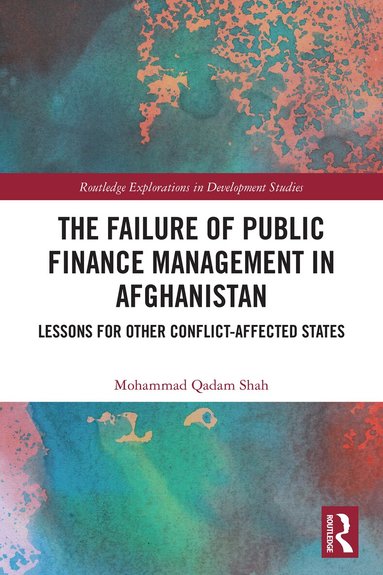
Failure of Public Finance Management in Afghanistan
- Vikt 0,38 kg
706 krhos Bokus · exkl. frakt
213 kr skillnad mellan billigaste och dyraste butik i lager
Dubbelkollat idag
Jämför 2 butiker
- Bokus, 706 kr, frakt enligt butiken. Till butik (öppnas i ny flik)
I lagerFrakt: se butikenDubbelkollad 06:51
706 kr
Lägst
- Akademibokhandeln, 919 kr, frakt enligt butiken. Till butik (öppnas i ny flik)
I lagerFrakt: se butikenDubbelkollad 06:53
919 kr

Priser från butikernas flöden kan ha ändrats: det är priset hos butiken som gäller, så kontrollera det innan du handlar.
Prishistorik
Köp nu eller vänta?
Just nu kostar produkten 706 kr — 8 kr över det lägsta vi sett på 2 veckor.
Under den tiden har det oftast legat runt 700–710 kr.
Pris idag
706 kr
- Lägst
- 698 kr
- Snitt
- 714 kr
- Högst
- 909 kr
| 2026-09-30 | 909 kr · Lägst hos Akademibokhandeln |
|---|---|
| 2026-10-01 | 698 kr · Lägst hos Bokus |
| 2026-10-03 | 699 kr · Lägst hos Bokus |
| 2026-10-04 | 701 kr · Lägst hos Bokus |
| 2026-10-05 | 702 kr · Lägst hos Bokus |
| 2026-10-08 | 709 kr · Lägst hos Bokus |
| 2026-10-10 | 708 kr · Lägst hos Bokus |
| 2026-10-11 | 706 kr · Lägst hos Bokus |
| 2026-10-12 | 704 kr · Lägst hos Bokus |
| 2026-10-16 | 706 kr · Lägst hos Bokus |
Om produkten
Failure of Public Finance Management in Afghanistan
Läs merLäs mindre
In rebuilding conflict-affected states, a major portion of foreign aid focuses on reforming public finance management systems and supporting annual budgets. However, how budgets are allocated and how reforms take shape in practice remain critical questions.This book analyzes the politics of reform and budget allocation in the most expensive liberal state-building effort in history: Afghanistan. Through a detailed political economy analysis, it explores the origin, continuity, and evolution of Afghanistan's centralized public finance management system. Such centralization, readopted in the 2004 Constitution, constrained local participation, perpetuated inequities, and undermined predictability and transparency. Key reforms including the "Provincial Development Planning Guideline" and "Provincial Budgeting Policy" aimed to address these shortcomings but failed due to political resistance, elite capture, and structural inefficiencies. The analysis reveals informal dynamics behind the allocation of discretionary development budget consisting of the Afghan central government's political considerations (political relationship, political importance, and strength and weakness of local administrations) and lobbying strategies of local actors. This dynamic enabled the central government to continue to use public funds for purchasing political legitimacy to remain in power.Afghanistan's case highlights the limits of externally driven state-building that prioritizes centralization over local dynamics. The book offers key lessons on inclusive governance, structural barriers, and sustainable public finance reforms in conflict-affected states. It appeals to donors, development experts, and researchers in public finance, foreign aid, security, and development studies.
Specifikationer
Fakta
- Vikt
- 0,38 kg
- GTIN
- 09781032658537
Uppgifter från tillverkare och butiker.