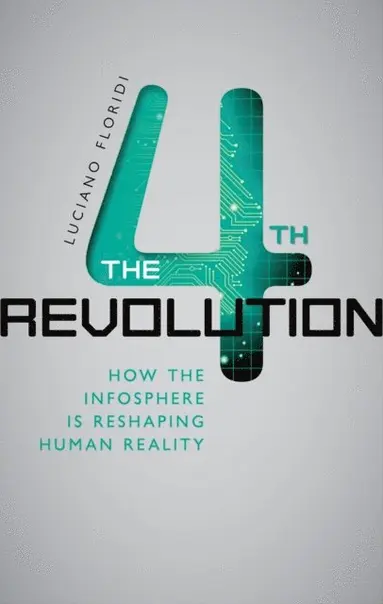
Fourth Revolution
Dubbelkollat idag
Jämför 1 butik
- Bokus, 147 kr, frakt enligt butiken. Till butik (öppnas i ny flik)
I lagerFrakt: se butikenDubbelkollad 06:51
147 kr
Lägst

Priser från butikernas flöden kan ha ändrats: det är priset hos butiken som gäller, så kontrollera det innan du handlar.
Prishistorik
Köp nu eller vänta?
Just nu kostar produkten 147 kr — 38 kr över det lägsta vi sett på 1 månad.
Under den tiden har det oftast legat runt 110–150 kr.
Pris idag
147 kr
- Lägst
- 109 kr
- Snitt
- 136 kr
- Högst
- 147 kr
| 2026-09-15 | 144 kr · Lägst hos Bokus |
|---|---|
| 2026-09-29 | 109 kr · Lägst hos Bokus |
| 2026-10-11 | 147 kr · Lägst hos Bokus |
Om produkten
Who are we, and how do we relate to each other?
Läs merLäs mindre
Luciano Floridi, one of the leading figures in contemporary philosophy, argues that the explosive developments in Information and Communication Technologies (ICTs) is changing the answer to these fundamental human questions. As the boundaries between life online and offline break down, and we become seamlessly connected to each other and surrounded by smart, responsive objects, we are all becoming integrated into an "infosphere". Personas we adopt in social media, for example, feed into our ''real'' lives so that we begin to live, as Floridi puts in, "onlife". Following those led by Copernicus, Darwin, and Freud, this metaphysical shift represents nothing less than a fourth revolution. "Onlife" defines more and more of our daily activity - the way we shop, work, learn, care for our health, entertain ourselves, conduct our relationships; the way we interact with the worlds of law, finance, and politics; even the way we conduct war. In every department of life, ICTs have become environmental forces which are creating and transforming our realities. How can we ensure that we shall reap their benefits? What are the implicit risks? Are our technologies going to enable and empower us, or constrain us? Floridi argues that we must expand our ecological and ethical approach to cover both natural and man-made realities, putting the ''e'' in an environmentalism that can deal successfully with the new challenges posed by our digital technologies and information society.