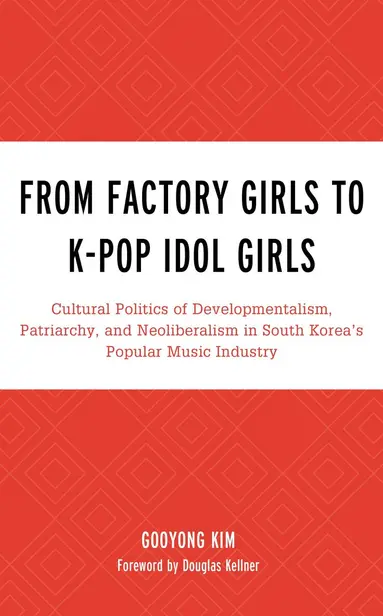
From Factory Girls to K-Pop Idol Girls
- Vikt 0,3 kg
558 krhos Bokus · exkl. frakt
171 kr skillnad mellan billigaste och dyraste butik i lager
Dubbelkollat idag
Jämför 2 butiker
- Bokus, 558 kr, frakt enligt butiken. Till butik (öppnas i ny flik)
I lagerFrakt: se butikenDubbelkollad 10:51
558 kr
Lägst
- Akademibokhandeln, 729 kr, frakt enligt butiken. Till butik (öppnas i ny flik)
I lagerFrakt: se butikenDubbelkollad 11:18
729 kr

Priser från butikernas flöden kan ha ändrats: det är priset hos butiken som gäller, så kontrollera det innan du handlar.
Prishistorik
Köp nu eller vänta?
Just nu kostar produkten 558 kr — 7 kr över det lägsta vi sett på 1 månad.
Under den tiden har det oftast legat runt 550–560 kr.
Pris idag
558 kr
- Lägst
- 551 kr
- Snitt
- 557 kr
- Högst
- 563 kr
| 2026-09-15 | 557 kr · Lägst hos Bokus |
|---|---|
| 2026-09-17 | 553 kr · Lägst hos Bokus |
| 2026-09-19 | 552 kr · Lägst hos Bokus |
| 2026-09-20 | 551 kr · Lägst hos Bokus |
| 2026-09-23 | 552 kr · Lägst hos Bokus |
| 2026-09-24 | 551 kr · Lägst hos Bokus |
| 2026-10-02 | 554 kr · Lägst hos Bokus |
| 2026-10-04 | 556 kr · Lägst hos Bokus |
| 2026-10-10 | 562 kr · Lägst hos Bokus |
| 2026-10-12 | 558 kr · Lägst hos Bokus |
| 2026-10-16 | 562 kr · Lägst hos Bokus |
| 2026-10-17 | 560 kr · Lägst hos Bokus |
| 2026-10-22 | 559 kr · Lägst hos Bokus |
| 2026-10-24 | 561 kr · Lägst hos Bokus |
| 2026-10-27 | 562 kr · Lägst hos Bokus |
| 2026-10-28 | 563 kr · Lägst hos Bokus |
| 2026-11-01 | 558 kr · Lägst hos Bokus |
Om produkten
From Factory Girls to K-Pop Idol Girls
Läs merLäs mindre
Focusing on female idols' proliferation in the South Korean popular music (K-pop) industry since the late 1990s, Gooyong Kim critically analyzes structural conditions of possibilities in contemporary popular music from production to consumption. Kim contextualizes the success of K-pop within Korea's development trajectories, scrutinizing how a formula of developments from the country' rapid industrial modernization (1960s-1980s) was updated and re-applied in the K-pop industry when the state had to implement a series of neoliberal reformations mandated by the IMF. To that end, applying Michel Foucault's discussion on governmentality, a biopolitical dimension of neoliberalism, Kim argues how the regime of free market capitalism updates and reproduces itself by 1) forming a strategic alliance of interests with the state, and 2) using popular culture to facilitate individuals' subjectification and subjectivation processes to become neoliberal agents. As to an importance of K-pop female idols, Kim indicates a sustained utility/legacy of the nation's century-long patriarchy in a neoliberal development agenda. Young female talents have been mobilized and deployed in the neoliberal culture industry in a similar way to how un-wed, obedient female workers were exploited and disposed on the sweatshop factory floors to sustain the state's export-oriented, labor-intensive manufacturing industry policy during its rapid developmental stage decades ago. In this respect, Kim maintains how a post-feminist, neoliberal discourse of girl power has marketed young, female talents as effective commodities, and how K-pop female idols exert biopolitical power as an active ideological apparatus that pleasurably perpetuates and legitimates neoliberal mantras in individuals' everyday lives. Thus, Kim reveals there is a strategic convergence between Korea's lingering legacies of patriarchy, developmentalism, and neoliberalism. While the current K-pop literature is micro-scopic and celebratory, Kim advances the scholarship by multi-perspectival, critical approaches. With a well-balanced perspective by micro-scopic textual analyses of music videos and macro-scopic examinations of historical and political economy backgrounds, Kim's book provides a wealth of intriguing research agendas on the phenomenon, and will be a useful reference in International/ Intercultural Communication, Political Economy of the Media, Cultural/ Media Studies, Gender/ Sexuality Studies, Asian Studies, and Korean Studies.
Specifikationer
Fakta
- Vikt
- 0,3 kg
- GTIN
- 09781498548847
Uppgifter från tillverkare och butiker.