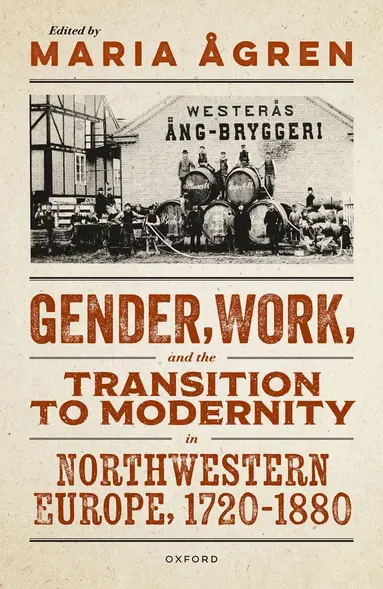
Gender, Work, and the Transition to Modernity in Northwestern Europe, 1720-1880
- Vikt 0,64 kg
1 516 krhos Bokus · exkl. frakt
453 kr skillnad mellan billigaste och dyraste butik i lager
Dubbelkollade priser
Jämför 3 butiker
- Bokus, 1 516 kr, frakt enligt butiken. Till butik (öppnas i ny flik)
I lagerFrakt: se butikenDubbelkollad 11:51
1 516 kr
Lägst
- Akademibokhandeln, 1 969 kr, frakt enligt butiken. Till butik (öppnas i ny flik)
I lagerFrakt: se butikenDubbelkollad 11:53
1 969 kr
- Adlibris, 1 466 kr, frakt enligt butiken. Till butik (öppnas i ny flik)
Slut i lagerFrakt: se butikenDubbelkollad 27 okt. 09:10
1 466 kr


Priser från butikernas flöden kan ha ändrats: det är priset hos butiken som gäller, så kontrollera det innan du handlar.
Prishistorik
Köp nu eller vänta?
Just nu kostar produkten 1 516 kr — 69 kr över det lägsta vi sett på 1 månad.
Under den tiden har det oftast legat runt 1 470–1 520 kr.
Pris idag
1 516 kr
- Lägst
- 1 447 kr
- Snitt
- 1 493 kr
- Högst
- 1 516 kr
| 2026-09-15 | 1 447 kr · Lägst hos Adlibris |
|---|---|
| 2026-09-16 | 1 466 kr · Lägst hos Adlibris |
| 2026-10-04 | 1 516 kr · Lägst hos Bokus |
| 2026-10-05 | 1 466 kr · Lägst hos Adlibris |
| 2026-10-08 | 1 516 kr · Lägst hos Bokus |
Om produkten
Gender, Work, and the Transition to Modernity in Northwestern Europe, 1720-1880
Läs merLäs mindre
It is well-known that gender distinctions structure the modern labour market, but why is this so and how far back in time does the pattern extend? Gender, Work, and the Transition to Modernity in Northwestern Europe, 1720-1880 uses a unique method to map and explain how gender rather than marital status came to be important. Gender, Work, and the Transition to Modernity in Northwestern Europe, 1720-1880 investigates how and why the division of work between men and women changed in the transition from early modern to modern society. Based on the verb-oriented method and around 19,000 observations of work activities in historical sources, its focus is on a mid-Swedish local society in the period 1720 to 1880. There were several continuities across this time: both women and men were observed in practically all forms of work, many households (both affluent and destitute) still relied on multiple sources of income, and the marital partnership continued to be important for what women and men did to support themselves. Yet, there was also change: tasks that conferred authority were gradually masculinised, the differences between married and unmarried women with respect to work declined, and while women remained mobile, men's work-related mobility increased. In an even longer time perspective, from 1550 to 1880, gender slowly became more important for what types of work people did. The main reason behind this development was increasing social differentiation and shifts in labour relations. The growing impact of gender was not the result of a trickling down of new middle-class ideals, nor the effect of new preferences, nor a consequence of a separation of home and work. Instead, differences grew because more people were in a position where someone else - an employer - controlled how they used their time.
Specifikationer
Fakta
- Vikt
- 0,64 kg
- GTIN
- 09780198934295
Uppgifter från tillverkare och butiker.