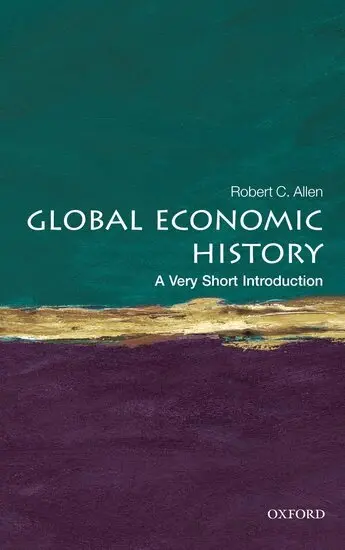
Global Economic History
- Vikt 0,15 kg
Dubbelkollat idag
Jämför 2 butiker
- Bokus, 114 kr, frakt enligt butiken. Till butik (öppnas i ny flik)
Slut i lagerFrakt: se butikenDubbelkollad 06:51
114 kr
- Akademibokhandeln, 139 kr, frakt enligt butiken. Till butik (öppnas i ny flik)
Slut i lagerFrakt: se butikenDubbelkollad 06:53
139 kr

Priser från butikernas flöden kan ha ändrats: det är priset hos butiken som gäller, så kontrollera det innan du handlar.
Prishistorik
Köp nu eller vänta?
- Lägst
- 111 kr
- Snitt
- 114 kr
- Högst
- 139 kr
| 2026-09-15 | 111 kr · Lägst hos Bokus |
|---|---|
| 2026-10-04 | 114 kr · Lägst hos Bokus |
| 2026-10-28 | 139 kr · Lägst hos Akademibokhandeln |
| 2026-10-31 | Ingen butik hade produkten i lager |
Om produkten
Why are some countries rich and others poor?
Läs merLäs mindre
In 1500, the income differences were small, but they have grown dramatically since Columbus reached America. Since then, the interplay between geography, globalization, technological change, and economic policy has determined the wealth and poverty of nations. The industrial revolution was Britain's path breaking response to the challenge of globalization. Western Europe and North America joined Britain to form a club of rich nations by pursuing four polices-creating a national market by abolishing internal tariffs and investing in transportation, erecting an external tariff to protect their fledgling industries from British competition, banks to stabilize the currency and mobilize domestic savings for investment, and mass education to prepare people for industrial work. Together these countries pioneered new technologies that have made them ever richer. Before the Industrial Revolution, most of the world's manufacturing was done in Asia, but industries from Casablanca to Canton were destroyed by western competition in the nineteenth century, and Asia was transformed into 'underdeveloped countries' specializing in agriculture. The spread of economic development has been slow since modern technology was invented to fit the needs of rich countries and is ill adapted to the economic and geographical conditions of poor countries. A few countries - Japan, Soviet Russia, South Korea, Taiwan, and perhaps China - have, nonetheless, caught up with the West through creative responses to the technological challenge and with Big Push industrialization that has achieved rapid growth through investment coordination. Whether other countries can emulate the success of East Asia is a challenge for the future.ABOUT THE SERIES: The Very Short Introductions series from Oxford University Press contains hundreds of titles in almost every subject area. These pocket-sized books are the perfect way to get ahead in a new subject quickly. Our expert authors combine facts, analysis, perspective, new ideas, and enthusiasm to make interesting and challenging topics highly readable.
Specifikationer
Fakta
- Vikt
- 0,15 kg
- GTIN
- 09780199596652
Uppgifter från tillverkare och butiker.