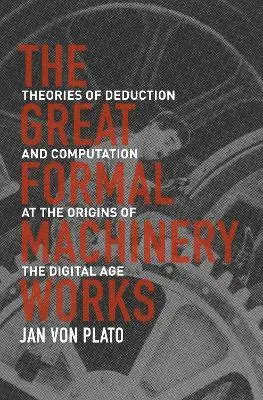
Great Formal Machinery Works
- Vikt 0,68 kg
656 krhos Bokus · exkl. frakt
193 kr skillnad mellan billigaste och dyraste butik i lager
Dubbelkollat idag
Jämför 2 butiker
- Bokus, 656 kr, frakt enligt butiken. Till butik (öppnas i ny flik)
I lagerFrakt: se butikenDubbelkollad 16:51
656 kr
Lägst
- Akademibokhandeln, 849 kr, frakt enligt butiken. Till butik (öppnas i ny flik)
I lagerFrakt: se butikenDubbelkollad 16:53
849 kr

Priser från butikernas flöden kan ha ändrats: det är priset hos butiken som gäller, så kontrollera det innan du handlar.
Prishistorik
Köp nu eller vänta?
Just nu kostar produkten 656 kr — 280 kr över det lägsta vi sett på 1 månad.
Under den tiden har det oftast legat runt 480–650 kr.
Pris idag
656 kr
- Lägst
- 376 kr
- Snitt
- 533 kr
- Högst
- 755 kr
| 2026-09-15 | 475 kr · Lägst hos Bokus |
|---|---|
| 2026-09-19 | 376 kr · Lägst hos Bokus |
| 2026-09-21 | 377 kr · Lägst hos Bokus |
| 2026-09-22 | 475 kr · Lägst hos Bokus |
| 2026-09-27 | 381 kr · Lägst hos Bokus |
| 2026-09-29 | 475 kr · Lägst hos Bokus |
| 2026-10-09 | 384 kr · Lägst hos Bokus |
| 2026-10-12 | 385 kr · Lägst hos Bokus |
| 2026-10-13 | 475 kr · Lägst hos Bokus |
| 2026-10-14 | 649 kr · Lägst hos Bokus |
| 2026-10-17 | 755 kr · Lägst hos Bokus |
| 2026-10-22 | 603 kr · Lägst hos Bokus |
| 2026-10-27 | 656 kr · Lägst hos Bokus |
Om produkten
Great Formal Machinery Works
Läs merLäs mindre
The information age owes its existence to a little-known but crucial development, the theoretical study of logic and the foundations of mathematics. The Great Formal Machinery Works draws on original sources and rare archival materials to trace the history of the theories of deduction and computation that laid the logical foundations for the digital revolution. Jan von Plato examines the contributions of figures such as Aristotle; the nineteenth-century German polymath Hermann Grassmann; George Boole, whose Boolean logic would prove essential to programming languages and computing; Ernst Schroder, best known for his work on algebraic logic; and Giuseppe Peano, cofounder of mathematical logic. Von Plato shows how the idea of a formal proof in mathematics emerged gradually in the second half of the nineteenth century, hand in hand with the notion of a formal process of computation. A turning point was reached by 1930, when Kurt Godel conceived his celebrated incompleteness theorems.They were an enormous boost to the study of formal languages and computability, which were brought to perfection by the end of the 1930s with precise theories of formal languages and formal deduction and parallel theories of algorithmic computability. Von Plato describes how the first theoretical ideas of a computer soon emerged in the work of Alan Turing in 1936 and John von Neumann some years later. Shedding new light on this crucial chapter in the history of science, The Great Formal Machinery Works is essential reading for students and researchers in logic, mathematics, and computer science.
Specifikationer
Fakta
- Vikt
- 0,68 kg
- GTIN
- 09780691174174
Uppgifter från tillverkare och butiker.