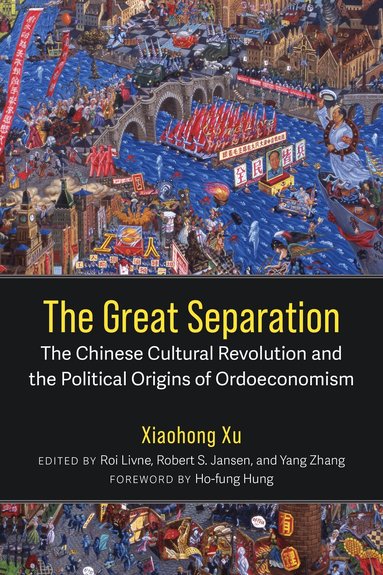
Great Separation
463 krhos Bokus · exkl. frakt
136 kr skillnad mellan billigaste och dyraste butik i lager
Dubbelkollat idag
Jämför 2 butiker
- Bokus, 463 kr, frakt enligt butiken. Till butik (öppnas i ny flik)
I lagerFrakt: se butikenDubbelkollad 14:51
463 kr
Lägst
- Akademibokhandeln, 599 kr, frakt enligt butiken. Till butik (öppnas i ny flik)
I lagerFrakt: se butikenDubbelkollad 14:53
599 kr

Priser från butikernas flöden kan ha ändrats: det är priset hos butiken som gäller, så kontrollera det innan du handlar.
Prishistorik
Köp nu eller vänta?
Pris idag
463 kr
- Lägst
- 413 kr
- Snitt
- 460 kr
- Högst
- 539 kr
| 2026-10-10 | 539 kr · Lägst hos Akademibokhandeln |
|---|---|
| 2026-10-11 | 413 kr · Lägst hos Bokus |
| 2026-10-13 | 463 kr · Lägst hos Bokus |
Om produkten
Great Separation
Läs merLäs mindre
With a keen attention to how culture and elite conflict shape politics, The Great Separation upends deterministic understandings of the Chinese Cultural Revolution and the market reforms that followed. This ambitious posthumous volume by sociologist Xiaohong Xu turns the existing scholarship on China's "neoliberalism" on its head by demonstrating that the effort to separate mass politics from economic policy had its origins well before the Reform and Opening-up era. Over the course of the Cultural Revolution, unfolding factional dynamics and interpretive struggles enabled Chairman Mao and his radical colleagues to mobilize workers to advance their own political goals while neutralizing the masses' economic demands, symbolically separating the political from the economic. This set the stage for a more thoroughgoing depoliticization of the economy after 1989, when China faced challenges from students and workers whose economic grievances had rapidly morphed into political demands for democracy. The result was what Xu calls ordoeconomism: an ideology that valorizes economic development, rejects mass politics, and views the state as the apolitical guardian of the economy. As Xu demonstrates, while ordoeconomism may share some affinities with neoliberalism, it is a distinctively Chinese approach that must be understood on its own terms.