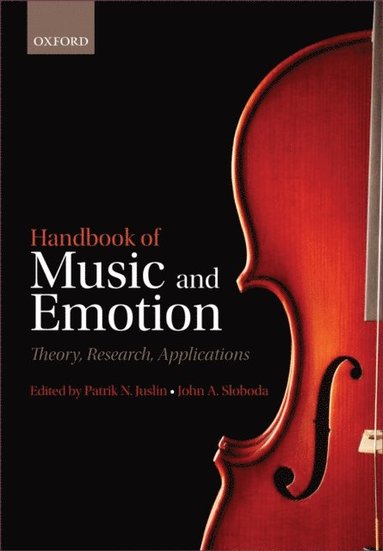
Handbook of Music and Emotion
Dubbelkollat idag
Jämför 1 butik
- Bokus, 772 kr, frakt enligt butiken. Till butik (öppnas i ny flik)
I lagerFrakt: se butikenDubbelkollad 05:51
772 kr
Lägst

Priser från butikernas flöden kan ha ändrats: det är priset hos butiken som gäller, så kontrollera det innan du handlar.
Prishistorik
Köp nu eller vänta?
Just nu kostar produkten 772 kr — 289 kr över det lägsta vi sett på 1 månad.
Under den tiden har det oftast legat runt 480–770 kr.
Pris idag
772 kr
- Lägst
- 483 kr
- Snitt
- 673 kr
- Högst
- 772 kr
| 2026-09-15 | 756 kr · Lägst hos Bokus |
|---|---|
| 2026-09-29 | 483 kr · Lägst hos Bokus |
| 2026-10-09 | 494 kr · Lägst hos Bokus |
| 2026-10-11 | 772 kr · Lägst hos Bokus |
Om produkten
Handbook of Music and Emotion
Läs merLäs mindre
Music''s ability to express and arouse emotions is a mystery that has fascinated both experts and laymen at least since ancient Greece. The predecessor to this book ''Music and Emotion'' (OUP, 2001) was critically and commercially successful and stimulated much further work in this area. In the years since publication of that book, empirical research in this area has blossomed, and the successor to ''Music and Emotion'' reflects the considerable activity in this area. The Handbook of Music and Emotion offers an ''up-to-date'' account of this vibrant domain. It provides comprehensive coverage of the many approaches that may be said to define the field of music and emotion, in all its breadth and depth. The first section offers multi-disciplinary perspectives on musical emotions from philosophy, musicology, psychology, neurobiology, anthropology, and sociology. The second section features methodologically-oriented chapters on the measurement of emotions via different channels (e.g., self report, psychophysiology, neuroimaging). Sections three and four address how emotion enters into different aspects of musical behavior, both the making of music and its consumption. Section five covers developmental, personality, and social factors. Section six describes the most important applications involving the relationship between music and emotion. In a final commentary, the editors comment on the history of the field, summarize the current state of affairs, as well as propose future directions for the field. The only book of its kind, The Handbook of Music and Emotion will fascinate music psychologists, musicologists, music educators, philosophers, and others with an interest in music and emotion (e.g., in marketing, health, engineering, film, and the game industry). It will be a valuable resource for established researchers in the field, a developmental aid for early-career researchers and postgraduate research students, and a compendium to assist students at various levels. In addition, as with its predecessor, it will also attract interest from practising musicians and lay readers fascinated by music and emotion.