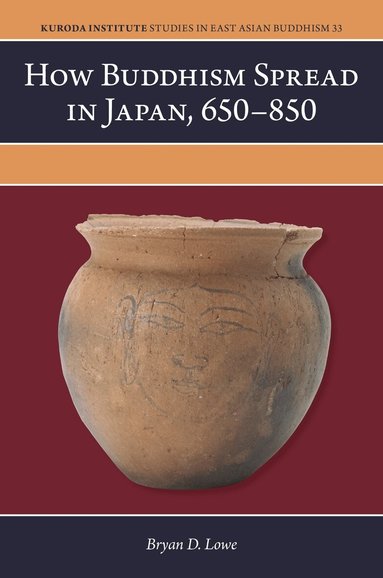
How Buddhism Spread in Japan, 650-850
777 krhos Bokus · exkl. frakt
232 kr skillnad mellan billigaste och dyraste butik i lager
Dubbelkollat idag
Jämför 2 butiker
- Bokus, 777 kr, frakt enligt butiken. Till butik (öppnas i ny flik)
I lagerFrakt: se butikenDubbelkollad 19:51
777 kr
Lägst
- Akademibokhandeln, 1 009 kr, frakt enligt butiken. Till butik (öppnas i ny flik)
I lagerFrakt: se butikenDubbelkollad 19:53
1 009 kr

Priser från butikernas flöden kan ha ändrats: det är priset hos butiken som gäller, så kontrollera det innan du handlar.
Prishistorik
Köp nu eller vänta?
Pris idag
777 kr
- Lägst
- 777 kr
- Snitt
- 810 kr
- Högst
- 1 009 kr
| 2026-10-11 | 1 009 kr · Lägst hos Akademibokhandeln |
|---|---|
| 2026-10-12 | 777 kr · Lägst hos Bokus |
Om produkten
How Buddhism Spread in Japan, 650-850
Läs merLäs mindre
Between the late seventh and early ninth centuries, Japan changed from a land largely without Buddhism to a country where Buddhist ideas, images, and practices were everywhere. The introduction of Buddhism transformed the social and intellectual life of the provinces. Regions that once lacked temples suddenly had so many that virtually every village had a place of worship nearby. People began to understand their world in new ways, imagining previously inconceivable possibilities for themselves in this life and the next. This was arguably the most dramatic religious transformation in the history of Japan. How Buddhism Spread in Japan is the first book to tell the story of this religious revolution in the Japanese provinces. Bryan D. Lowe, a leading expert on Japanese religions, argues against the standard view that Buddhism first reached ordinary people in the provinces in the twelfth and thirteenth centuries. This bold study offers a new narrative for the history of Japanese religions, one that dates Buddhism's spread centuries earlier than standard accounts. Lowe highlights the agency of provincial patrons, mobile monks, female preachers, and rural villagers, who worked together to bring Buddhism to the Japanese countryside. How Buddhism Spread in Japan also introduces new methods for reading archaeological and textual materials in tandem. Drawing upon an archive of hundreds of thousands of pieces of inscribed pottery, roof tiles, and wooden slips, it uses material culture to uncover the religious lives of villagers on the geographic and social margins of Japan. Lowe reads this corpus alongside Buddhist tales and previously untranslated preaching notes to reconstruct the worldview and practices of provincial villagers. He combines archaeological and preaching materials to access this otherwise invisible world. Written in accessible and engaging prose, How Buddhism Spread in Japan undermines long-cherished narratives in the field of Japanese Buddhism and makes a methodological intervention of interest to scholars of classical and medieval studies more broadly.