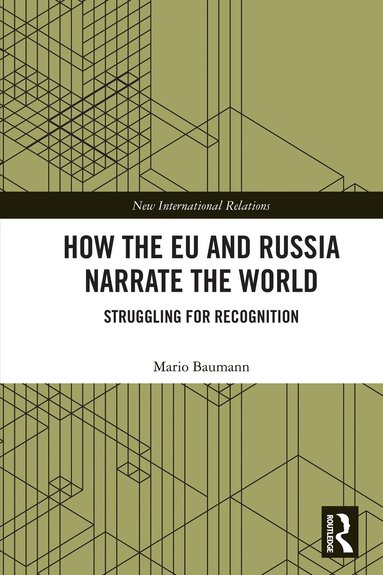
How the EU and Russia Narrate the World
- Vikt 0,45 kg
706 krhos Bokus · exkl. frakt
213 kr skillnad mellan billigaste och dyraste butik i lager
Dubbelkollat idag
Jämför 2 butiker
- Bokus, 706 kr, frakt enligt butiken. Till butik (öppnas i ny flik)
I lagerFrakt: se butikenDubbelkollad 07:51
706 kr
Lägst
- Akademibokhandeln, 919 kr, frakt enligt butiken. Till butik (öppnas i ny flik)
I lagerFrakt: se butikenDubbelkollad 07:53
919 kr

Priser från butikernas flöden kan ha ändrats: det är priset hos butiken som gäller, så kontrollera det innan du handlar.
Prishistorik
Köp nu eller vänta?
Just nu kostar produkten 706 kr — 8 kr över det lägsta vi sett på 2 veckor.
Under den tiden har det oftast legat runt 700–710 kr.
Pris idag
706 kr
- Lägst
- 698 kr
- Snitt
- 715 kr
- Högst
- 909 kr
| 2026-09-30 | 909 kr · Lägst hos Akademibokhandeln |
|---|---|
| 2026-10-01 | 698 kr · Lägst hos Bokus |
| 2026-10-04 | 701 kr · Lägst hos Bokus |
| 2026-10-05 | 702 kr · Lägst hos Bokus |
| 2026-10-08 | 709 kr · Lägst hos Bokus |
| 2026-10-10 | 708 kr · Lägst hos Bokus |
| 2026-10-11 | 706 kr · Lägst hos Bokus |
| 2026-10-12 | 704 kr · Lägst hos Bokus |
| 2026-10-16 | 706 kr · Lägst hos Bokus |
Om produkten
How the EU and Russia Narrate the World
Läs merLäs mindre
In times of increasing challenges to 'the Western idea,' this book illuminates how Russian and EU foreign policy discourses interact. While official Russian and EU articulations on issues of sovereignty, human rights and the shared neighbourhood diverge greatly, they are not articulated in isolation but are entangled and condition each other. To understand this entanglement, this book approaches the relationship between Russia and the EU as an intersubjective one, a social context where diverging interpretations of the world struggle for hegemony. Its theoretical framework marries poststructuralist thought with insights from critical approaches to Hegelian recognition dialectics. Based on an extensive and systematic empirical discourse analysis of Russian and EU foreign policy texts, this study draws a detailed picture of the intensifying discursive dynamics accompanying the deteriorating relationship between Brussels and Moscow. It shows how neither the EU's nor Russia's foreign policy articulation has changed substantially. The interaction pattern continues to be an asymmetrical one with Russia's articulations much more conditioned by the EU's discourse than vice versa. The book thus argues that the EU is more independent in sovereignly articulating an interpretation of the world, whereas Russia continues to face constraints in the formulation of an autonomous political project. With its novel and innovative conceptual framework, this book furthers the theoretical scholarship on poststructuralism in international relations. It addresses all scholars interested in poststructuralist enquiries and will be of great value to students and scholars of Russian foreign policy and the EU.
Specifikationer
Fakta
- Vikt
- 0,45 kg
- GTIN
- 09781032872599
Uppgifter från tillverkare och butiker.