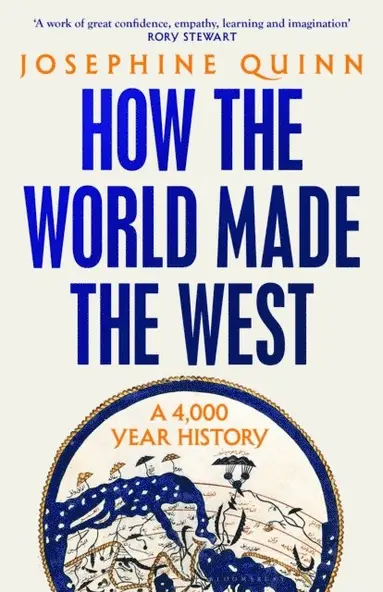
How the World Made the West
Dubbelkollade priser
Jämför 2 butiker
- Bokus, 183 kr, frakt enligt butiken. Till butik (öppnas i ny flik)
I lagerFrakt: se butikenDubbelkollad 02:51
183 kr
Lägst
- Adlibris, 173 kr plus 35 kr frakt. Till butik (öppnas i ny flik)
Slut i lagerFrakt 35 krDubbelkollad 27 okt. 09:10
173 kr


Priser från butikernas flöden kan ha ändrats: det är priset hos butiken som gäller, så kontrollera det innan du handlar.
Prishistorik
Köp nu eller vänta?
Just nu kostar produkten 183 kr — 12 kr över det lägsta vi sett på 1 månad.
Under den tiden har det oftast legat runt 170 kr.
Pris idag
183 kr
- Lägst
- 171 kr
- Snitt
- 175 kr
- Högst
- 183 kr
| 2026-09-15 | 171 kr · Lägst hos Adlibris |
|---|---|
| 2026-09-17 | 173 kr · Lägst hos Adlibris |
| 2026-10-06 | 179 kr · Lägst hos Bokus |
| 2026-10-08 | 173 kr · Lägst hos Adlibris |
| 2026-10-24 | 183 kr · Lägst hos Bokus |
Om produkten
How the World Made the West
Läs merLäs mindre
A BOOK OF THE YEAR FOR: The Times/Sunday Times, Observer, Economist, Guardian, BBC History Magazine, i-paper, Novara Media and History Today''Quinn has done a lot more than reinvent the wheel. What we have here is a truly encyclopaedic and monumental account of the ancient world'' THE TIMES''One of the most fascinating and important works of global history to appear for many years'' WILLIAM DALRYMPLEThe West, the story goes, was built on the ideas and values of Ancient Greece and Rome, which disappeared from Europe during the Dark Ages and were then rediscovered by the Renaissance. But what if that isn''t true?In a bold and magisterial work of immense scope, Josephine Quinn argues that the real story of the West is much bigger than this established paradigm leads us to believe. So much of our shared history has been lost, drowned out by the concept - developed in the Victorian era - of separate ''civilisations''.Moving from the Bronze Age to the Age of Exploration, How the World Made the West reveals a new narrative: one that traces the millennia of global encounters and exchange that built what is now called the West, as societies met, tangled and sometimes grew apart. From the creation of the alphabet by Levantine workers in Egypt, who in a foreign land were prompted to write things down in their own language for the first time, to the arrival of Indian numbers in Europe via the Arab world, Quinn makes the case that understanding societies in isolation is both out-of-date and wrong. It is contact and connections, rather than solitary civilisations, that drive historical change. It is not peoples that make history - people do.''A work of great confidence, empathy, learning and imagination'' RORY STEWART''Bold, beautifully written and filled with insights . . . Extraordinary'' PETER FRANKOPAN