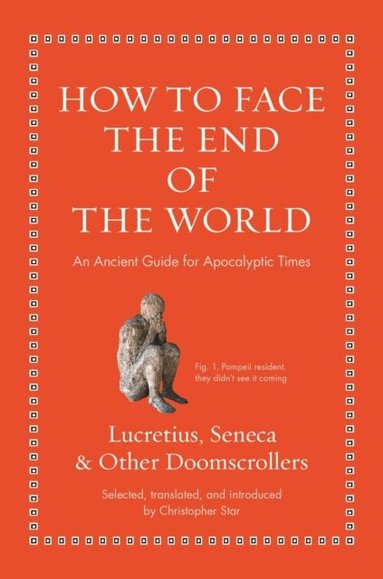
How to Face the End of the World
Dubbelkollat idag
Jämför 1 butik
- Bokus, 228 kr, frakt enligt butiken. Till butik (öppnas i ny flik)
I lagerFrakt: se butikenDubbelkollad 09:51
228 kr
Lägst

Priser från butikernas flöden kan ha ändrats: det är priset hos butiken som gäller, så kontrollera det innan du handlar.
Prishistorik
Köp nu eller vänta?
Just nu kostar produkten 228 kr — 4 kr över det lägsta vi sett på 2 veckor.
Pris idag
228 kr
- Lägst
- 224 kr
- Snitt
- 227 kr
- Högst
- 228 kr
| 2026-10-01 | 224 kr · Lägst hos Bokus |
|---|---|
| 2026-10-06 | 228 kr · Lägst hos Bokus |
Om produkten
How to Face the End of the World
Läs merLäs mindre
A grimly entertaining anthology of ancient Greek and Roman writings about how to fearlessly prepare for the end of the world and other disastersA remarkable percentage of people believe we are living in the end times, according to pollsters. Between the climate crisis, nuclear weapons, AI, and other existential threats, it's easy to see why. How should we think about the apocalypse? How can we mentally prepare for doomsday and other disasters? This anthology presents ancient Greek and Roman writings about the end of the worldfrom the poet Hesiod and his prediction that Zeus will destroy humanity to philosophers such as Plato, Lucretius, Seneca, and Epictetus, who viewed the end of the world as an inevitable and regular process of nature and the cosmos. These writersthe original doomscrollersshow how thinking about the annihilation of civilization or the planet can be instructive and healthy, and they seek to teach readers how to face catastrophe without fear.Featuring fresh new translations and an introduction, as well as the original Greek and Latin texts on facing pages, this collection presents stories and ideas that are both familiar and unfamiliar. Here, Plato invents the tale of Atlantis to illustrate the idea that civilization is periodically wiped out by natural disasters, the Epicureans envision total planetary destruction in a universe guided by natural laws, the Stoics theorize that the cosmos is repeatedly consumed by its ';creative fire' and then reborn, and much more.Along the way, we discover the ancient roots of modern doomsday prepping and postapocalyptic fiction. But most of all, we learn how thinking about the end of the world can be oddly reassuring and improve how we live today.