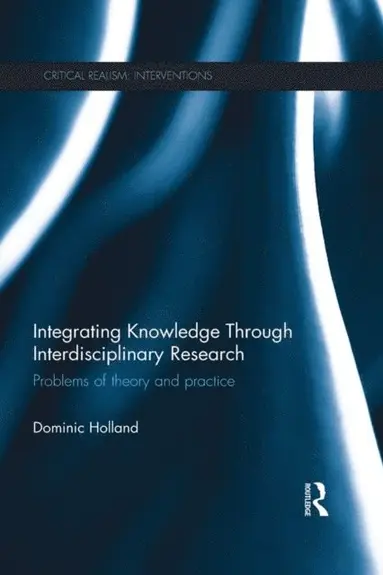
Integrating Knowledge Through Interdisciplinary Research
Dubbelkollat idag
Jämför 1 butik
- Bokus, 1 074 kr, frakt enligt butiken. Till butik (öppnas i ny flik)
I lagerFrakt: se butikenDubbelkollad 02:51
1 074 kr
Lägst

Priser från butikernas flöden kan ha ändrats: det är priset hos butiken som gäller, så kontrollera det innan du handlar.
Prishistorik
Köp nu eller vänta?
Just nu kostar produkten 1 074 kr — 23 kr över det lägsta vi sett på 1 månad.
Under den tiden har det oftast legat runt 1 070–1 140 kr.
Pris idag
1 074 kr
- Lägst
- 1 051 kr
- Snitt
- 1 116 kr
- Högst
- 1 142 kr
| 2026-09-15 | 1 127 kr · Lägst hos Bokus |
|---|---|
| 2026-09-19 | 1 142 kr · Lägst hos Bokus |
| 2026-09-27 | 1 051 kr · Lägst hos Bokus |
| 2026-09-30 | 1 142 kr · Lägst hos Bokus |
| 2026-10-15 | 1 074 kr · Lägst hos Bokus |
| 2026-10-20 | 1 142 kr · Lägst hos Bokus |
| 2026-10-24 | 1 074 kr · Lägst hos Bokus |
Om produkten
Integrating Knowledge Through Interdisciplinary Research
Läs merLäs mindre
In this important new text, Holland seeks to explain, by means of social scientific and philosophical inquiry, the difficulties that researchers often experience when attempting to integrate knowledge from different academic disciplines, either individually or as part of a team of subject specialists. It is argued that the difficulty of integrating knowledge from different academic disciplines is the result of, firstly, an inadequate justification of the nature of scientific integration and differentiation and, secondly, the dominance of disciplinary specialization in scientific inquiry.By focusing on both the theoretical justification for, and the practical feasibility of, integrating knowledge through interdisciplinary research, this book asks what properties of reality make the integration of knowledge from different academic disciplines possible and to what extent it is feasible to integrate knowledge through interdisciplinary research within a traditional, disciplinary context. Accordingly the text is both philosophical and social scientific in content: philosophical in the sense that it presents a theory of causal determination, which will help researchers to understand how reality is both differentiated and interconnected; social scientific in the sense that it presents the results of three case studies of collaborative interdisciplinary research projects.The book is heavily informed by the philosophy of critical realism. The philosophical argument about the possibility of integration and specialization in science draws explicitly on some of the key concepts of critical realism â€" particularly those comprising the theory of †̃integrative pluralismâ€TM â€" while critical realist assumptions underpin the social scientific argument about the causal influence of the social system of knowledge production. By exploring researchersâ€TM conceptions of knowledge and of reality on the one hand and their decisions about what sort of knowledge to produce on the other, Holland shows how the difficulty of scientific integration is both a problem of knowledge and a problem of knowledge production. This book is essential reading for students and academics interested in the emerging topic of knowledge integration and interdisciplinarity.