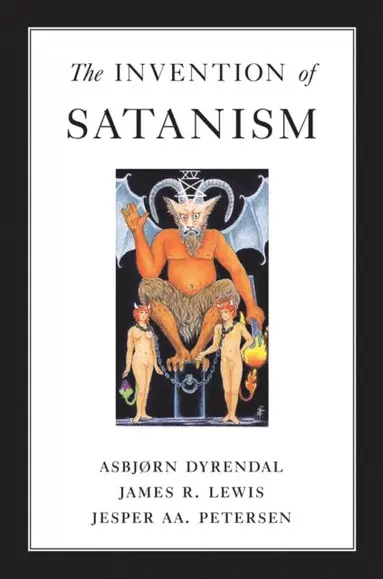
Invention of Satanism
Dubbelkollat idag
Jämför 1 butik
- Bokus, 642 kr, frakt enligt butiken. Till butik (öppnas i ny flik)
I lagerFrakt: se butikenDubbelkollad 22:51
642 kr
Lägst

Priser från butikernas flöden kan ha ändrats: det är priset hos butiken som gäller, så kontrollera det innan du handlar.
Prishistorik
Köp nu eller vänta?
Just nu kostar produkten 642 kr — 227 kr över det lägsta vi sett på 1 månad.
Under den tiden har det oftast legat runt 420–640 kr.
Pris idag
642 kr
- Lägst
- 415 kr
- Snitt
- 569 kr
- Högst
- 642 kr
| 2026-09-15 | 592 kr · Lägst hos Bokus |
|---|---|
| 2026-09-29 | 415 kr · Lägst hos Bokus |
| 2026-10-06 | 424 kr · Lägst hos Bokus |
| 2026-10-11 | 642 kr · Lägst hos Bokus |
Om produkten
Invention of Satanism
Läs merLäs mindre
Satanism is a complex phenomenon that has often been the source of controversy across social and rhetorical contexts. Some consider it the root of all evil. Others see it as a childish form of rebellion or as a misapplication of serious esoteric beliefs and practices. Still others consider it a specific religion or philosophy that serves as a form of personal and collective identity. In The Invention of Satanism, three experts explore Satanism as a contemporary movement that is in continuous dialogue with popular culture, and which provides a breeding ground for other new religious movements. By shifting the focus from mythology to meaning-making, this book examines the invention of Satanism among self-declared religious Satanists. Like all ideologists and believers, Satanists incorporate, borrow, and modify elements from other traditions; the authors investigate how traditional folklore and prior strands of occultism were synthesized by Anton LaVey in his founding of the Church of Satan and creation of the Satanic Bible. Later chapters discuss contemporary Satanist subcultures, demonstrating how Satanism continues to reinvent itself despite its brief history as an organized phenomenon. There are now numerous forms of Satanism with distinctive interpretations of what being a Satanist entails, with some of these new versions deviating more from the historical "mainstream" than others. In this fascinating account of a seemingly arcane and often-feared movement, Dyrendal, Lewis, and Petersen demonstrate that the invention of Satanism is an ongoing, ever-evolving process.