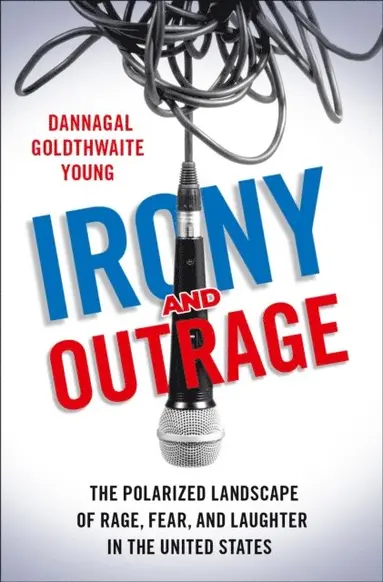
Irony and Outrage
Dubbelkollat idag
Jämför 1 butik
- Bokus, 225 kr, frakt enligt butiken. Till butik (öppnas i ny flik)
I lagerFrakt: se butikenDubbelkollad 02:51
225 kr
Lägst

Priser från butikernas flöden kan ha ändrats: det är priset hos butiken som gäller, så kontrollera det innan du handlar.
Prishistorik
Köp nu eller vänta?
Just nu kostar produkten 225 kr — 82 kr över det lägsta vi sett på 1 månad.
Under den tiden har det oftast legat runt 150–230 kr.
Pris idag
225 kr
- Lägst
- 143 kr
- Snitt
- 203 kr
- Högst
- 225 kr
| 2026-09-15 | 220 kr · Lägst hos Bokus |
|---|---|
| 2026-09-29 | 143 kr · Lägst hos Bokus |
| 2026-10-09 | 146 kr · Lägst hos Bokus |
| 2026-10-11 | 225 kr · Lägst hos Bokus |
Om produkten
Irony and Outrage
Läs merLäs mindre
For almost a decade, journalists and pundits have been asking why we don''t see successful examples of political satire from conservatives or of opinion talk radio from liberals. This book turns that question on its head to argue that opinion talk is the political satire of the right and political satire is the opinion programming of the left. They look and feel like two different animals because their audiences are literally, two different animals. In Irony and Outrage, political and media psychologist Dannagal Goldthwaite Young explores the aesthetics, underlying logics, and histories of these two seemingly distinct genres, making the case that they should be thought of as the logical extensions of the psychology of the left and right, respectively. One genre is guided by ambiguity, play, deliberation, and openness, while the other is guided by certainty, vigilance, instinct, and boundaries. While the audiences for Sean Hannity and John Oliver come from opposing political ideologies, both are high in political interest, knowledge, and engagement, and both lack faith in many of our core democratic institutions. Young argues that the roles that these two genres play for their viewers are strikingly similar: galvanizing the opinion of the left or the right, mobilizing citizens around certain causes, and expressing a frustration with traditional news coverage while offering alternative sources of information and meaning. One key way in which they differ, however, concludes Young, is in their capacity to be exploited by special interests and political elites. Drawing on decades of research on political and media psychology and media effects, as well as historical accounts and interviews with comedians and comedy writers, Young unpacks satire''s liberal "bias" and juxtaposes it with that of outrage''s conservative "bias." She details how traits like tolerance for ambiguity and the motivation to engage with complex ideas shape our preferences for art, music, and literature; and how those same traits correlate with political ideology. In turn, she illustrates how these traits help explain why liberals and conservatives vary in the genres of political information they prefer to create and consume.